Author: Andris Pone

  • Carney’s Pivot to Leviathan

    We have not successfully rolled back the frontiers of the state in Britain, only to see them re-imposed at a European level with a European super-state exercising a new dominance from Brussels.

    — Margaret Thatcher, Speech to the College of Europe (the “Bruges speech”), 20 September 1988

    Ten days ago, without a mandate, without a treaty text, and without the Chamber to which he owes his office being permitted so much as a debate, the Prime Minister of Canada stood in Strasbourg and offered our sovereignty as a diplomatic party favour. He accepted, on behalf of thirty-eight million people, an invitation to make Canada the European Union’s first-ever associate member, a status that does not exist in the EU’s founding treaties, has no legal definition, no cost, no scope, and no meaning that Ursula von der Leyen or Mark Carney has bothered to specify. It was, in the Prime Minister’s own hedging words to Reuters, up to the Europeans what to call it — as if the label were the point. It is not the point. The point is that the last man in Canada who should be entrusted with an open-ended pledge to Brussels has just made one.

    This is Carney’s pivot to Leviathan. It is not free trade — we already have that. It is not diversification — we already have that, too. It is the importation of a supranational regulatory apparatus, negotiated in secret, unratified by Parliament, and marketed to Canadians with the same technocratic condescension that this same man deployed against the British public a decade ago.

    The Canadian sheeple, spoon-fed the pablum of the CBC and the reflexive Europhilia of the corporate press, are being told this is a mature, prudent, sophisticated hedge against Donald Trump. It is nothing of the kind. It is a fourth term of the Trudeau government by other means, dressed in a better suit and delivered in an Oxbridge accent.

    Let us be precise about what has actually happened.

    What free trade with Europe already looks like

    Canada has enjoyed comprehensive, tariff-eliminated, market-access-guaranteed free trade with the European Union since 21 September 2017, under the Comprehensive Economic and Trade Agreement (CETA), negotiated by the Harper Conservatives and ratified provisionally under Trudeau. CETA eliminates roughly ninety-eight percent of tariff lines, opens EU public procurement, harmonizes standards recognition, and covers services, investment, and mobility. It is one of the most ambitious free-trade agreements the EU has ever signed with a non-European country.

    • If the objective were trade, the file was closed nine years ago.
    • If the objective were deeper trade, the answer would be the ten member states that have still not ratified CETA nationally — a demand that requires no new architecture, no new treaty, no new sovereignty transfer, and no press conference in Strasbourg.

    ‘Whatever associate membership means — and neither Ottawa nor Brussels can tell you — it is by definition something beyond CETA. It is regulatory alignment. It is judicial deference. It is the acquis communautaire — the accumulated body of European law and jurisprudence — imported into Canadian life through the back door. It is Ursula von der Leyen’s Commission, not our Parliament, writing the rules that govern our automotive standards, our data flows, our banks, our farms, our carbon pricing, and eventually — because it always ends there — the movement of people.

    If Mr. Carney wanted only free trade with Europe, he had it. He wants something else.

    The Governor of the Bank of England did his best work against Brexit

    To understand what is being offered, one must first understand the man doing the offering. Mark Carney’s globalist résumé is not incidental to this story. It IS the story.

    Between 2013 and 2020, Mr. Carney was Governor of the Bank of England (BoE). During the 2016 referendum on British membership in the European Union, he emerged as the single most active technocrat in the Remain campaign. He warned MPs on 12 May 2016 that a Leave vote could trigger a “technical recession”. He delivered a set-piece speech on 30 June 2016 declaring the vote a “major regime shift” that would weigh on prospects for “some time”. He cut rates and signalled cuts. He crossed every line a central-bank governor is meant not to cross, and he did so precisely because he believed — sincerely, deeply, and demonstrably wrongly — that democratic self-government was inferior to rule by Brussels.

    He was wrong on the direction and the magnitude of the risk. The recession did not come. Sterling adjusted. British GDP grew. British exports diversified. In hindsight, Carney’s Brexit interventions have aged as badly as any set of predictions by a serving central banker in modern memory. And yet the man who so misread Britain’s exit from Brussels is now asking Canadians to trust his judgement on our accession to it.

    That, on its own, ought to be enough to end the discussion.

    But the résumé does not stop there.

    • 2011–2018: Chair of the Financial Stability Board (FSB), the Basel-based body that coordinates financial regulation for the G20.
    • 2020–2025: Vice Chair, then Chair, of Brookfield Asset Management, and Head of Transition Investing, where he raised more than US$25 billion for private capital funds tied to net-zero transition.
    • 2020–2025: United Nations Special Envoy for Climate Action and Finance, and UK Finance Adviser for COP26.
    • 2021: Founder and Co-Chair of the Glasgow Financial Alliance for Net Zero (GFANZ), the private-finance coordinating body for aligning global capital with the net-zero agenda.
    • Since 2015 and continuing: Member, and now Chair, of the Group of Thirty (G30), the private consultative body of central bankers and academics.
    • Longstanding contributor to the World Economic Forum (WEF).

    This is not a Canadian curriculum vitae. It is the CV of a supranational courtier. Every institution on the list exists to constrain national democratic authority — the FSB over bank regulation, GFANZ over capital allocation, the UN Special Envoy over climate policy, the G30 as a permanent transnational advisory to central bankers, the WEF as a matchmaking service between Davos and the finance ministries of the West. Mr. Carney did not merely participate in these bodies. He built them, chaired them, and now brings their governing logic home.

    Hayek understood this species precisely eighty-one years ago:

    The unscrupulous and uninhibited are likely to be more successful in a society tending toward totalitarianism… central planning not only robbed people of their basic freedoms but ruined their economies.

    — Friedrich A. Hayek, The Road to Serfdom (1944), Chapter 10.

    The story Carney will not tell you: Europe’s decline

    The Prime Minister proposes to yoke Canada’s fate to a bloc whose defining characteristic in this century has been falling behind. This is not a partisan claim. It is the Commission’s own diagnosis. Mario Draghi’s 2024 report on European competitiveness — commissioned by the Commission itself — describes “slowing productivity, demographic challenges, rising energy costs”, and identifies an investment gap of roughly €800 billion per year simply to remain competitive with the United States and China.

    From 2008 to 2023, cumulative real gross domestic product (GDP) grew by roughly 87 percent in the United States and just 13.5 percent in the European Union. Europe once had a larger economy than America’s. It now trails by trillions of dollars, and the gap is widening.
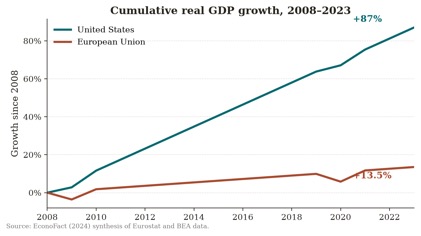
    Figure 1. Cumulative real GDP growth, 2008–2023. Source: EconoFact synthesis of Eurostat and BEA data.

    Europe is not the future Mr. Carney says it is. It is the cautionary tale. It is the developed world’s leading illustration of what happens to a continent that regulates rather than builds, litigates rather than innovates, borrows rather than earns, and pays the price in demographic contraction, energy dependency, industrial decline, and youth unemployment. This is the “partner” for whom Mr. Carney has walked away from the country that buys three of every four things we make.

    Meanwhile, an American reindustrialization

    While the European Union has been drafting the Digital Markets Act (DMA), the Digital Services Act (DSA), the General Data Protection Regulation (GDPR), the Artificial Intelligence Act (AI Act), and the Carbon Border Adjustment Mechanism (CBAM) — every one of them a regulation, not a factory — the United States has been busy at the more difficult work of building things. The Creating Helpful Incentives to Produce Semiconductors and Science Act (CHIPS and Science Act, 2022), the Inflation Reduction Act (IRA, 2022), and the Trump-era tariff wall have anchored the largest wave of American industrial investment since the Second World War.

    • Over US$500 billion in announced private semiconductor investment.
    • More than 100 projects across 28 states.
    • U.S. domestic chipmaking capacity on track to roughly triple by 2032.
    • Multi-decade highs in manufacturing construction spending across automotive, battery, liquefied natural gas (LNG), and heavy industry.
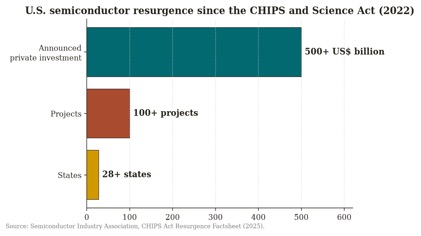
    Figure 2. U.S. semiconductor resurgence since the CHIPS and Science Act (2022). Source: Semiconductor Industry Association (2025).

    This is the economy on our southern border. It is the largest, richest, freest, most innovative market on earth, and Canada — a country whose exports are 75.9 percent destined for that market — has a Prime Minister who has walked away from its negotiating table and travelled to Strasbourg to court a stagnating alternative.
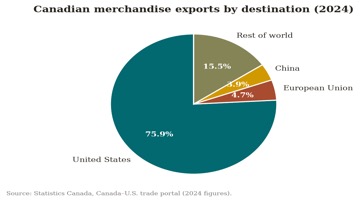
    Figure 3. Canadian merchandise exports by destination (2024). Source: Statistics Canada.

    Reagan warned us where this ends:

    In this present crisis, government is not the solution to our problem; government is the problem.

    — Ronald Reagan, First Inaugural Address, 20 January 1981.

    Canada’s problem is not the United States. It is us.

    The pivot to Brussels is being sold as a response to Donald Trump. It is not. It is a response to the fact that a decade of Liberal government has left this country structurally uncompetitive, and Mr. Carney has no plan to fix that, only a plan to hide it behind a European flag.

    • Canadian labour productivity growth has fallen from an annual 3.7 percent in the 1947–1973 era to an annual 1.7 percent through the late twentieth century to under 1 percent since 2000.
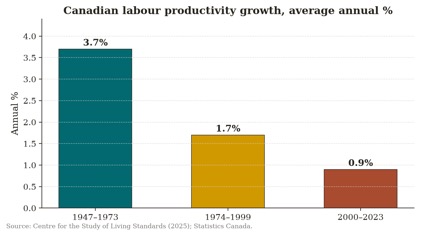
    Figure 4. Canadian labour productivity growth, average annual %. Source: Centre for the Study of Living Standards (2025).

    • Canadian real GDP per capita fell for six consecutive quarters into the third quarter of 2024, one of the deepest and longest per-person contractions in the developed world.
    • Population growth engineered through record immigration has masked what is, on a per-person basis, a decade of stagnation.
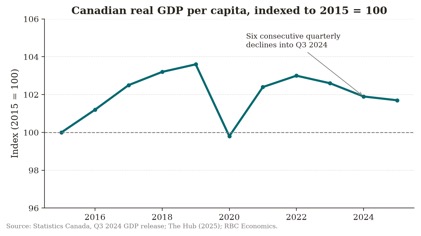
    Figure 5. Canadian real GDP per capita, indexed to 2015 = 100. Source: Statistics Canada Q3 2024 GDP release.

    Enoch Powell, whatever else his sins, was right about the constitutional condition precedent to any relationship with Brussels:

    The decisive step of accession to the Community must be conditional on the full-hearted consent of parliament and people.

    — Enoch Powell, House of Commons, 17 February 1972.

    The full-hearted consent of Parliament and people has not been sought, will not be sought if Mr. Carney can avoid it, and is precisely the sort of tiresome democratic irritation his career has been organized to route around.

    The changing story of the walkout

    On the night of 21 August 2026, the Prime Minister suspended trade negotiations with the United States and recalled our negotiators from Washington. The explanations have been, to put it charitably, a moving target.

    • Friday night, 21 August: the American proposals were “unfair”, “uneconomic”, and “called into question the reliability of any deal”.
    • Saturday, 22 August: the Americans “asked too much and offered too little”.
    • Same day, 22 August: it was about auto content, medium- and heavy-duty trucks, French-language protections, and Canada’s ability to sign trade deals with third parties.
    • Monday, 24 August: it was really about protecting the French language.
    • 26 August: we had been “attacked”.
    • 1 September: the Americans wanted to make Canadian industry into “subsidiaries” or “wipe it out”.
    • 3 September: the Prime Minister dismissed the American explanations as coming from “unelected” officials — a curious epithet from a man who had never sat as an elected Member of Parliament (MP) in his life prior to becoming Prime Minister.

    Every one of these explanations may contain some element of truth. But taken together, they are the story of a man manufacturing a rationale after the fact — because the actual reason for the walkout was that the pivot to Brussels was already in motion. The Wall Street Journal had confirmed, by 13 September, that Mr. Carney had directed his special envoy to Europe to scope the “most ambitious possibilities short of full membership”. This work did not begin after the American negotiations broke down. It preceded them.

    Canadians were not told the truth. We were told stories. Different stories on different days for different audiences.

    Who profits from the pivot?

    Every pivot has beneficiaries, and Canadians should ask, loudly and repeatedly, cui bono? Whose interests are aligned with the associate-membership project? Whose bank accounts, whose portfolios, whose consulting invoices, whose regulatory rents?

    The globalist consultancy class

    Under the Trudeau-Carney continuum, McKinsey & Company saw its federal contracts rise thirtyfold over the Harper baseline, culminating in the Auditor General’s finding that Ottawa had “flouted proper contracting policies” and could not demonstrate value for money on $209 million in McKinsey work. Deloitte, Accenture, KPMG, PwC, and Boston Consulting Group have all fed at the same trough. An associate-membership regime — with its endless “harmonization” tables, its “regulatory alignment” workstreams, its ESG-taxonomy translation exercises, and its perpetual Brussels-Ottawa reconciliation — is a ten-year consulting billing bonanza. It is a full-employment programme for the professional-managerial class of Ottawa, Toronto, Brussels, and Davos.

    The green-finance complex

    Mr. Carney did not spend a decade building the Glasgow Financial Alliance for Net Zero, chairing Brookfield’s ESG and Transition Investing platforms, and drafting the UN’s climate-finance framework as a hobby. He built a capital-allocation architecture. That architecture requires jurisdictions willing to embed its taxonomies, its disclosure regimes, and its regulatory tilts into domestic law. EU rules — the Corporate Sustainability Reporting Directive, the Sustainable Finance Disclosure Regulation, and CBAM — are the finished article. Associate membership is how you import them without a domestic legislative fight. The beneficiaries are the funds, the fund managers, the transition-financing intermediaries, and the ESG-compliance industry, which happens to be the industry Mr. Carney is most personally identified with in the world.

    The Laurentian courtier class

    Gerald Butts — Justin Trudeau’s principal secretary, architect of the carbon tax, chief author of the “post-national state” — has since 2018 been Vice Chairman of the Eurasia Group, the political-risk consultancy run by Ian Bremmer. Gerald’s brother, Fox Butts (Fox Carney), is also a senior advisor at Eurasia Group. Mark Carney and Gerald Butts have moved in the same institutional orbits for two decades. When you understand that the Eurasia Group’s core product is pricing sovereign-risk to global capital, and that the Ottawa-Brussels alignment project is precisely the sort of complex, multi-year, multi-jurisdictional file that a firm like Eurasia bills against for a decade, the picture clarifies itself.

    Quebec’s supply-managed dairy oligopoly

    Under CETA, Ottawa carved out protections for supply-managed dairy. Quebec’s roughly 4,200 dairy farms — commanding 37 percent of national output while the western provinces are capped at 16 percent — have been political untouchables under every Liberal government of the modern era. It is not accidental that among the three “red lines” that reportedly killed the American negotiation was the protection of French-language rules and, by extension, the cultural-policy architecture that shields Quebec’s dairy oligopoly from consumer choice. Watch the associate-membership file carefully: Quebec’s protected sectors will emerge intact.

    Bay Street’s regulatory-arbitrage layer

    The tax lawyers, the securities lawyers, the compliance officers, the ESG consultants, and the professional-services partnerships that make their living navigating overlapping regulatory regimes will do very well indeed out of a Canada with one foot in North America and one foot in Brussels. Complexity is a business model, and this is complexity by the shipload.

    Who loses

    • Alberta and Saskatchewan. The energy sector that has funded transfer payments for two generations. Every European regulatory framework Mr. Carney admires is hostile to Canadian oil, Canadian gas, Canadian LNG, and Canadian pipelines. The CBAM alone is designed to tax exactly what Alberta produces.
    • Ontario’s automotive corridor. Deep alignment with EU standards means divergence from the U.S. standards that govern the assembly plants in Windsor, Oshawa, Cambridge, Ingersoll, and Oakville — plants whose supply chains cross the American border thousands of times a year.
    • Manitoba, Saskatchewan, and Alberta’s grain and livestock farmers. They will keep facing EU non-tariff barriers on hormones, genetically modified crops, and animal welfare that no “associate membership” will remove, while their dairy competitors in Quebec keep their walled garden.
    • The Canadian small-business owner and the incorporated professional. They already labour under a top marginal integrated rate of tax that exceeds fifty percent, an interprovincial trade wall the Organisation for Economic Co-operation and Development (OECD) ranks among the worst in the developed world, and a regulatory apparatus that has strangled a generation of entrepreneurship. To this they are now asked to add Brussels’ regulatory perimeter.
    • The Canadian voter. Because none of this has been put to them.

    Churchill saw the shape of it a century ago, and it holds:

    But we have our own dream and our own task. We are with Europe, but not of it. We are linked, but not comprised. We are interested and associated, but not absorbed.

    — Winston S. Churchill, Saturday Evening Post, 15 February 1930.

    Churchill’s “associated but not absorbed” is the honest formulation. Mr. Carney’s associate member is the dishonest one, precisely because he cannot tell you where the association ends and the absorption begins — and he does not want to.

    Carney’s contempt for Parliament

    Every step of this file has been executed as a fait accompli, presented to Parliament and to Canadians after the fact, and defended with the technocrat’s usual mixture of vague reassurance and impatient condescension. There has been:

    • No treaty text.
    • No costed impact analysis.
    • No white paper.
    • No consultation with the provinces on areas of exclusive or concurrent jurisdiction, including securities, resource development, agriculture, culture, and education.
    • No indication of whether Parliament will be given a vote before Canadian negotiators sign anything.
    • No indication of whether the Canadian people will be given a referendum on a change to our external relations that in scope and effect is of constitutional character.

    This is not new. It is, in fact, the through-line of the Carney premiership. He governs by summit, statement, and press availability. He inherited a prorogation still under Federal Court of Appeal challenge and publicly denied ever contemplating another one — while retaining every prerogative to invoke it. He has never sat as an elected MP before his elevation; his prior career is exhaustively institutional and central-banking — the Bank of Canada, the Bank of England, the FSB, the G30, the UN Special Envoy role, Brookfield, GFANZ. Every one of those institutions is designed to insulate decision-making from parliamentary and electoral accountability. That is not a bug on his résumé. It is the résumé.

    The fundamental Liberal continuity

    Canadians who supported Mr. Carney in the belief that he represented a break from the Trudeau decade have been misled. He was Justin Trudeau’s principal economic adviser through the most destructive five years of that government. He has retained Chrystia Freeland’s fiscal architecture in all its essential contours. He has kept the emissions cap in modified form, kept the industrial carbon regime, kept the interprovincial trade wall, kept the equalization arithmetic, kept the bureaucracy — a 40 percent expansion under Trudeau — and now proposes to import the European Union’s regulatory operating system on top of it.

    The consumer carbon tax was scrapped for optics. The capital-gains inclusion rate increase was scrapped for optics. The Productivity Mega-Deduction announced on 15 September 2026, welcome as it is, is a tacit confession that everything the government did between 2015 and 2026 made this country uninvestable. It does not undo the damage. It merely reduces the marginal effective tax rate (METR) on new investment from roughly 13 percent to 6.4 percent — a good measure that arrives after a decade of the opposite policy from the same political movement.

    This is not reform. This is the same Liberal Party rearranging the deck chairs on the same ship, painting Brussels stars on the hull, and telling Canadians the iceberg is our fault for standing too close to America.

    What Canadians should ask, plainly

    • What does associate membership mean, in law? Show us the treaty text — before, not after.
    • Which chapters of the acquis communautaire will Canada adopt? Agriculture? Financial services? Digital? Environmental? Labour? Immigration?
    • Who arbitrates disputes? The Court of Justice of the European Union (CJEU)? A joint body? Canadian courts? On which subject-matters is the sovereignty of Parliament ceded?
    • Will there be an election on this, a referendum, or neither?
    • Given Mr. Carney’s 2016 Brexit warnings — systematically wrong on direction and magnitude — what accountability does he offer for asking Canadians to trust his EU judgement in 2026?
    • Which industries, professions, and regions gain? Which lose? Where is the sectoral impact study?
    • What is the disposition of our relationship with the United States — the market that buys three of every four Canadian goods — while this alignment proceeds?
    • Why should a Prime Minister who declined to release a fully costed election platform be trusted to disclose the true cost of a treaty relationship of this magnitude?

    The bottom line

    Canada’s problem is not that we are too close to the United States. Canada’s problem is that fifty years of policy — accelerated dramatically in the last ten — has made us uncompetitive within North America. The rational response is to fix Canada: cut marginal rates, dismantle interprovincial trade barriers, approve the energy corridor, restore capital-formation incentives, rein in the federal payroll, and rationalize regulation with the largest, richest, fastest-growing developed economy on earth — the one on our southern border.

    Mr. Carney’s response is to import the regulatory framework of a slower, older, poorer, more indebted, more bureaucratic bloc — while walking away from the negotiating table with the country that buys three of every four things we make. He is doing so without a mandate, without a treaty text, without a costed impact study, without the consent of Parliament, and without the full-hearted consent — Powell’s phrase, and it is the right one — of the Canadian people.

    He is doing so because his entire career has been organized around the proposition that democratic self-government is inferior to expert supranational governance. He was wrong about that in Britain in 2016. He is wrong about it in Canada in 2026.

    Free trade with Europe? We have that. It is called CETA and it has been in force for nine years. What Mr. Carney proposes is different in kind. It is undefined, undemocratic, unratified, and — arguably — a fourth term of a government the country intended to retire.

    Leviathan must be stopped.

    But we have our own dream and our own task. We are with Europe, but not of it. We are linked, but not comprised. We are interested and associated, but not absorbed.

    — Winston S. Churchill, 1930. It was good counsel for Britain then. It is good counsel for Canada now.

    Trevor R. Parry, M.A., LL.B., LL.M. (Tax), CLU, TEP, Barrister & Solicitor

  • Bring back bourbon

    Here I am at the Grand Hotel, Mackinac Island, Michigan, drinking bourbon that is mostly verboten in Canada.

    A toast to bringing it back, as soon as possible, to shelves north of the border.

    Elbows up is not the way. Unless you are drinking.

  • Canada is broken. Prove me wrong.

    1. Canada is in broad national decline.
    2. The Liberal government has weakened Canada’s institutions and economy.
    3. Justin Trudeau damaged Canada’s prosperity and national identity.
    4. Mark Carney is continuing the same political direction as the Trudeau government.
    5. Canada’s relationship with the United States has significantly deteriorated.
    6. Anti-American sentiment in Canada has increased dramatically.
    7. Canada’s GDP per capita has fallen behind peer nations.
    8. Canada is losing its economic competitiveness.
    9. Canada no longer performs at a G7 economic standard.
    10. Canada’s manufacturing base has eroded.
    11. Canadians are becoming less happy.
    12. Young Canadians are increasingly pessimistic about the future.
    13. Affordability in Canada has collapsed.
    14. Government-supported oligopolies are driving up consumer costs.
    15. Food prices in Canada are excessively high.
    16. Government taxation has made alcohol unnecessarily expensive.
    17. Canadian cellphone and data prices are among the highest in the world.
    18. Western alienation is growing.
    19. Alberta separatism is gaining momentum.
    20. Quebec separatism remains a serious threat to national unity.
    21. Saskatchewan is developing separatist sentiment.
    22. Foreign interference has infiltrated Canadian political life.
    23. The federal government failed to implement a meaningful foreign agent registry.
    24. Canada has lost a coherent national identity.
    25. Historical revisionism is undermining Canada’s cultural continuity.
    26. Canadian historical figures are being unfairly vilified and erased.
    27. Canadian students are no longer properly taught Canadian history.
    28. Educational curricula increasingly reject traditional Western perspectives.
    29. Shakespeare has been displaced in schools as part of cultural decline.
    30. Indigenous land claims are creating economic and legal uncertainty.
    31. Property rights in Canada are becoming less secure.
    32. The British Columbia NDP government has accelerated these problems.
    33. Church burnings in Canada have been largely ignored.
    34. Authorities have failed to adequately prosecute attacks on churches.
    35. Lawyers are excessively profiting from Indigenous land-claim settlements.
    36. Taxpayer money is being consumed by massive legal payouts.
    37. Multiculturalism has fragmented Canadian society.
    38. Radical Islamist influences are being tolerated in Canada.
    39. Support for Hamas-linked activism has become normalized.
    40. Anti-Semitism in Canada is rising.
    41. Jewish schools require armed security because public safety has deteriorated.
    42. Universities are tolerating anti-Semitism.
    43. Canada is refusing to develop its natural resources.
    44. Federal policy is hostile toward oil and gas development.
    45. Canada failed to capitalize on liquefied natural gas opportunities.
    46. Canada lacks a strategic oil reserve.
    47. Selling Canada’s gold reserves was a strategic mistake.
    48. The rule of law in Canada is weakening.
    49. Race-based sentencing has undermined equal justice.
    50. Gladue principles have weakened sentencing consistency.
    51. Revolving-door bail policies are putting criminals back on the streets.
    52. Gun control laws unfairly target lawful firearm owners.
    53. Illegal gun smuggling is the real source of gun crime in Canada.
    54. The Nova Scotia mass shooting demonstrated the limits of gun bans.
    55. Mainstream media is politically biased in favour of Liberals.
    56. Government funding has compromised media independence.
    57. Affirmative action policies undermine equality before the law.
    58. Charter Section 15(2) entrenches preferential treatment policies.
    59. Free speech in Canada is under threat.
    60. Online hate legislation threatens civil liberties.
    61. Online harms laws are expanding state censorship.
    62. Religious expression is increasingly vulnerable to legal restriction.
    63. Canada’s infrastructure is dysfunctional.
    64. Domestic air travel in Canada is excessively expensive.
    65. The Eglinton Crosstown project symbolizes government incompetence.
    66. Canadian downtowns are deteriorating.
    67. Homelessness is worsening across Canada.
    68. Open drug use has become normalized in major cities.
    69. Municipal governance is failing in many urban centres.
    70. Canadian roads and infrastructure are badly neglected.
    71. Canada’s declining birth rate is creating a demographic crisis.
    72. Immigration is rapidly transforming Canada’s demographics.
    73. Canada’s healthcare system is collapsing.
    74. Emergency room wait times are unacceptable.
    75. Canada lacks adequate MRI capacity.
    76. Canadians increasingly leave the country for medical treatment.
    77. MAID reflects a broader moral and societal decline.
    78. Canada is losing talent and skilled workers to other countries.
    79. Capital flight from Canada is accelerating.
    80. Anti-business regulations are driving investment away.
    81. High taxation is forcing people and businesses out of Canada.
    82. Multiculturalism has produced ethnic fragmentation.
    83. Identity politics has replaced shared national identity.
    84. Canada’s position on Israel is weak and politically motivated.
    85. Electoral considerations are shaping Canadian foreign policy.
    86. Canada’s military is underfunded and ineffective.
    87. Canada manipulated accounting to meet NATO spending commitments.
    88. Naval procurement delays reflect deep institutional dysfunction.
    89. Delays in the F-35 program have weakened Canada’s defence readiness.
    90. DEI policies are undermining military effectiveness.
    91. Political ideology is interfering with combat readiness in the armed forces.
    92. Immigration pathways into the military create security concerns.
    93. Canada cannot adequately defend the Arctic.
    94. The Emergencies Act was used unconstitutionally against convoy protesters.
    95. Public trust in the judiciary is eroding.
    96. Trust in Canadian institutions has collapsed.
    97. Canada’s national debt is dangerously high.
    98. Canada’s debt-to-GDP ratio is unsustainable.
    99. Government employment has expanded excessively.
    100. Private sector employment is shrinking.
    101. The temporary foreign worker program harms Canadian workers.
    102. Young Canadians are struggling to secure entry-level jobs.
    103. Canada’s immigration system is vulnerable to abuse.
    104. Refugee claims are being exploited to avoid deportation.
    105. Judges are issuing lighter sentences to protect immigration status.
    106. Government censorship is expanding.
    107. Canada is drifting toward authoritarian governance.
    108. Canadian productivity is in long-term decline.
    109. Canada is falling behind in technological innovation.
    110. Investment capital is steadily leaving Canada.
    111. Canadian voters continue to reward failed leadership.
    112. Canada’s future trajectory is deeply concerning.
    113. Confidence in Canadian public institutions is historically low.
    114. Canada’s sovereignty is weakening.
    115. Western cultural traditions are under attack in Canada.
    116. Government power is becoming increasingly intrusive.
    117. Political and institutional elites are disconnected from ordinary Canadians.
    118. Canada is experiencing broader civilizational decline.
    119. Canada requires political resistance and national renewal.

    Watch / listen to this episode of my podcast on:

    LinkedIn

    YouTube

    Spotify

    Apple

  • Merch!

    Delighted to announce that we have hats, t-shirts and cigar cutters for you, solid black with a very simple message:

    LEVIATHAN MUST BE STOPPED.

    Want yours? Contact me at trevor@trevorparry.com.

  • What kind of friend is Canada?

    In recent weeks, the Liberal Party of Canada has attempted to engineer its resurrection by foisting the spectre of America as Canada’s enemy. This accompanied by a choreographed leadership campaign married to a politically-motivated prorogation of Parliament that should have most Canadians outraged. It is lamentable that it does not and certainly does not bode well for our future that Canadians have not demanded a return of Parliament and is evidence of our further slide into the swamp of apathy.

    Do Canadians even have the capacity for independent thought any longer? We used to snobbishly look down at our American cousins because we “understood” what was going on in the world. We sewed the maple leaf to our backpacks and pompously declared that the average Canadian could name at least six countries in Europe and maybe even their capital cities. Oh, how things have changed. The average Canadian, spoon-fed the socialist pablum of the CBC and the bilge of the other corporate media eunuchs are stretched to name anyone prominent in history outside the celebrated heroes of victimhood, which has replaced history in the first post-national state. If the polls are to be believed, and I think there is some chicanery in them, a great swath of the Canadian sheeple have returned to the Liberal fold, believing that a two-time central banker and trustee of the World Economic Forum is their saviour.

    Canadians, when asked why President Trump is acting this way to Canada, do not for an instant think that perhaps maybe our current government might have something to do with it. Yes, President Trump will not rest until the Stars and Stripes fly over the subdued remains of South Porcupine. I hate to break it to you folks, the whole 51st state thing is a ruse meant to knock Canadian negotiators back on their heels, and it worked splendidly. Donald Trump did not like the trade deal he negotiated during his first term, and a good collection of his advisors on the issue are back for the victory lap. Certainly, he would like to secure access to Canadian resources at the best possible price, but he envisions a transaction not an invasion.

    Perhaps we might consider what Trump’s worldview is, along with that of his principal advisors. It might be a shock to some that his views might actually be widely held in the national security community. One must look to statements made by others, including from past administrations about how Canada has come to be viewed in Washington. Certainly, the days of “Irish eyes are smiling,” and Canadian soldiers punching way above their weight class in Kandahar are long gone, replaced with the smug patronizing words and actions of the Prince Dauphin, Justin the First and his band of entitled social justice warriors, Karens and legions of “consultants.” 

    Canadians need to face facts. Canada under this abominable government have become not just freeloaders and whinging do-nothings; they have on many occasions taken actions that have jeopardized the Western Alliance and our American neighbours.  Getting the Canadian government to drop Huawei from building a great deal of our 5G network was the modern equivalent of shoveling out the Augean stables. Canada has sold significant stake in our resources to Chinese companies. The former Director General of Intelligence of the RCMP, Cameron Otis, was convicted of spying for a foreign power and given a paltry 14-year sentence when by all rights he should have been on a one-way trip to Tyburn. In 2019, Obama senior advisor Susan Rice questioned if Canada should continue to be in the intelligence-sharing relationship referred to as the Five Eyes. Recently those concerns have been raised again.

    Doing business with China can be an essential part of economic prosperity, but when your closest ally, and that includes Democrats and Republicans, question your commitment to national security and trustworthiness then perhaps you might conclude that the foundation for continued trust and comradery is eroded. A firm grasp of Chinese history and likely motivations must underpin our engagement with them; trust but verify.

    Enter Justin Trudeau who cannot seem to miss the opportunity to make some bold pronouncement, whether it is on Canada’s newfound resolve or his preference for Trump’s soundly-defeated opponent. Justin Trudeau is the anathema to everything the Trump administration portrays. Trump has many reasons to dislike Trudeau, and no reason to forgive. Whether forgiveness is a virtue Trump possesses remains a question, but that is largely irrelevant; Trudeau has transgressed and continues to do so. Despite his “resignation,” he simply won’t shut up or simply go away.

    What the Liberals have done to the Canadian military is criminal, eliminating combat effectiveness and readiness with tattooed zampolits enforcing the edict “diversity is our strength.” Well, our officer corps might understand gender dysphoria, but I doubt highly they can execute a mission. Our procurement, no doubt rife with graft, is a disgrace. Our shipbuilding program is 10 years delayed and almost 300% over budget. We had to lease F-18s from Australia as ours, service well-done, belong in museums or as exhibitions in front of local Legion halls.

    Intelligence and espionage have always been characterized as the world of the shadows. Canadians perhaps should wonder what we do not know. We certainly do not know the details of foreign interference in our elections, despite two pathetic attempts to whitewash the whole affair. We still don’t know the names, and it is pathetic that Canadians haven’t demanded them.

    Canada has a robust defense industry, highly integrated with that of the U.S. Have these companies, or the projects that they are working on, been compromised? Has the Trudeau government moved forcefully to protect advanced technologies or, like so many of its other failings and questionable decisions, moved to cloak these breaches in secrecy and denial? If U.S. national security is largely based on maintaining a technological edge, will they be comfortable with an “ally” who are vulnerable to theft?

    I am a realist in my view of foreign policy and national security. I see Canada’s future as a robust one, so long as we understand how our growth, our culture and our standard of living have been and remain inexorably tied to our American cousins. Donald Trump is not a dictator, nor does he plan to be one. He is a patriot who follows a Nixonian view of the world sharpened by his experience of building a real estate empire in New York City, where manners and nuance come a distant second to street sense and a good right cross. He was elected in a landslide and is widely supported by Americans who see him as the tonic to domestic rot and international decline. Canadians need to accept that fact.

    It is time for Canadians to step back and ask the key questions: why are the Americans doing what they are doing? And did our government’s negligence and questionable loyalty drive them to it?

    This article also appears on LinkedIn.

  • Why bring an economist to a poker game?

    The decision of the Trump Administration to impose a 25% across the board tariff on the import of Canadian goods, with a lower tariff on oil, has been analysed ad nauseum by economists and policy wonks in Canada. They rightly point out that it will actually increase costs to the American consumer, and that when you net out oil the US actually enjoys a trade surplus with Canada.

    They are all missing the point. There have been some who have raised the possibility that this is part of a new economic strategy being adopted by the new administration. Eschewing “free” trade arrangements and using tariffs to create revenue to allow for a commensurate decrease in U.S income tax, both individual and corporate might have some underlying relevance to the imposition of tariffs. Fears of a new age of mercantilism are secondary at best to the analysis, although all of the discourse and analysis has been well meaning and largely helpful. If the voter can understand policy and critical thinking this bodes well for democracy.

    One need looks at how President Trump has approached every “challenge” in his life. For him, in many cases it is a zero-sum game, or at least he better be seen as winning in the eyes of the public. Trump approaches policy from a Nixonian perspective, and adds in the dominant criteria, personal relationship, and character as the dominant factor. He speaks of having good or great relationships with many world leaders, many who are considered pariahs by the policy apparatus and mainstream media. There is creditability to his weltanschauung, as evidenced by the capitulation of Hamas and the meaningful progress towards resolution of the war in Ukraine.

    I am not saying this is the “right” way to do trade and foreign policy, but the Imperial model is what we have, and for the sake of Canada’s economy we better understand that and implement policies that cater to that. Trump is singularly focused on winning in the wake of a failed Biden administration where appeasement, faux brinksmanship and capitulation were the primary characteristics. He feels the call of history, to save his country, restore it to greatness and to firmly carve his name into history. Donald Trump, love him or hate him (there is no middle) is simply the most consequential President since Ronald Reagan.

    In Canada’s case I have written that this is the time for introspection as well. The current government, which stinks like rotten fish, is attempting to use Trump’s tariffs as a new wedge issue and Hail Mary to keep power at all costs and cover up the most despicable record in Canadian history. This has more to due with the once proud Liberal Party of Canada that has transformed into a cult of personality, and redistribution conduit to the donor class. My commentary regarding the current Prime Minister has been called “hate” by some. My unfiltered language does borrow from literature, history, and philosophy, and certainly might be at times vitriolic, but given the damage done to this once great country, which may be irreparable, by Mr. Trudeau and his quisling co-conspirators, I get a pass on that.

    Canada needs to first arrest the threat of tariffs by getting on Trump’s good side. Premier Smith has taken the right course, and lower tariffs on oil is the immediate result. Doug Ford, running for re-election, has no choice to adopt some form of bravado, but might consider a pilgrimage to Mar a Lago. Ford and Trump are both personal relationships focused and likely find common ground. The primary issue in all of this dispute, in my opinion is based on one personal relationship alone, not economics, not shared history, not even “common sense.”  Justin Trudeau is an effete elitist, the very definition of silver spooned, who is in every measure a zealot on the issues of a perceived climate emergency and gender. He embodies everything that Donald Trump hates. Add to this the fact that Trudeau simply cannot keep his mouth shut, that he has not missed an opportunity to insult Trump now, during the campaign, and throughout his debauched 10-year government.

    Canada needs to address structural issues that have prevented it from its true potential. Wide open immigration which has upended our social safety net, made entry level employment impossible for “old stock” Canadians and contributed to a marked increase in crime needs to reverse. (Please note, I do not blame these folks for working hard. I do blame lazy Canadians who since COVID have become addicted to government). Legalization of drugs (beyond cannabis) has not resulted in control of that market, but instead accelerated widespread addiction, urban decay, and crime. Our military has been transformed into a band of out of shape, unarmed social justice warriors due to command structure which is dominated by Soviet style zampolits rather than war fighters. Interprovincial trade, pipelines, supply management are all things that need to be addressed and remedied in short order.

    But the central problem remains the continued public presence of Justin Trudeau. He simply will not go away.  There is no “conversion on the road to Damascus” coming for President Trump. He demands a very public win. And like the recent 24-hour dispute with Colombia, that win must seen as victory in a clash of personalities. This win is simply defined, Justin Trudeau must leave office immediately. Justin Trudeau must realize or be told; he has no hand to play. It is time to fold and leave the table. Parliament must be recalled and an election called. There is no constitutional provision of fiat that says the Liberal Party of Canada has a God given right to pick a leader before an election. They can go into the campaign and pick their leader after they are dealt the electoral obliteration they so clearly deserve.

    In the resolute words of Lord Amery, Depart, I say, and let have done with you. In the name of God, go.

    This article also appears on LinkedIn.

  • How Donald Trump Saved Canada

    The inauguration of Donald Trump to his second term following a campaign by which Trump dominated by every electoral metric including popular vote, swing states and overall victory in the Electoral College has been either discounted or not understood by the current Canadian government, and unfortunately too many Canadians. The defeat of Kamala Harris was not just a defeat of the weakest Democratic candidate since Michael Dukakis, but a repudiation, in fact a “smack down,” of Obamaism and the “progressivism” that some have said characterized his politics and policies. Identity politics, bloated government, diminishment of national pride with a commensurate decline in military prowess (real or perceived), lawlessness, open borders, and a threat to core principles of the American Dream have been stopped cold and with Tocquevillian predictability the American state has returned to its aspirational trajectory.

    Canadians have coiled in the recent threat to impose an across-the-board 25% tariff on Canadian exports. They understand at a DNA level that such actions would not just be harmful to Canada, but potentially existential. This has left many in a pondering quandary, wondering why Trump has made such bellicose threats and how we might stop them. Some, not gauging to any extent that Canada came to a gun fight with a herring, make ludicrous counter threats such as “everything is on the table” (note here that I completely applaud the actions and statements of Doug Ford, who is doing exactly what the Premier of Ontario should be doing).

    I have written tireless volumes on why Justin Trudeau is without measure the worst Prime Minister that Canada has ever endured. He took his father’s penchant for generating national discord and transformed it into a Frankenstein’s monster with real economic effects, most notably for Western Canada, but also for the whole country. His zealous devotion to woke ideology and gender nonsense, coupled with a self-righteous personality makes him a truly loathsome creature. That would all have been tolerable had Trudeau not, on countless occasions, taken the opportunity to take a “progressive” swipe at Donald Trump, his policies and quite frankly the vision of America shared by a majority of its citizens.

    Trump’s response, called petulant by some, is completely expected. His call to absorb Canada as the 51st state speaks from Trump’s core values of celebrating victory and displaying trophies. Whether Canada should (less Quebec) become part of the United States I fear is an expanded essay if not a book project in itself. I would simply say that Trudeau’s fundamental and harmful rendering of Canada over the last ten years makes it impossible to dismiss the call to statehood out of hand. My own preference is a common market without a currency union but with unified defence command (Canada would maintain separate units and regiments).

    The immediate Canadian tariff crisis is ended with one simple action, namely the immediate departure by the Little Prince from public life. He can retire to Tofino where he has apparently constructed a small palace to enjoy his halcyon years of planned surfing, yoga, and rainbow unicorn pronouncements. Perhaps his recent interviews on CNN and MSNBC were in fact auditions.

    Trump is well-advised on Canadian issues and politics. Some of his key advisors have substantial and tangible ties to Canada. Their views are anti-Laurentian elite, anti-woke, anti-bloated government and pro-profit, pro-resource and in many ways pro-Canadian (at least what Canada was and should be again). Once Trudeau has departed – and make no mistake, the Governor General by proroguing Parliament not only failed in her constitutional duty, but also has done great harm to this country – we can get on with repairing our relationship with the United States.

    Repairing that relationship must be done in the context of President Trump’s weltanschauung. Canada must enact substantive immigration reform, returning to the Harper-era “points system” and asking forcefully many who came here under opaque reasons to return home. That must be matched with collective federal and provincial action to deliver a swift kick in the ass who think that living off the dole is acceptable (this is what happens when you lock your population in their homes and give them free money). The new federal government must unfetter the energy sector, allowing for the rising tide of being an energy superpower status to float all boats. This federal government has horribly treated Alberta and Saskatchewan and they must be allowed to enjoy the potential fruits of a rejuvenated Confederation. Canada must finally step up a be a true partner in defending the continent and as a “paid up” NATO member. We must repair our relationship with the Five Eyes countries. The announcement that Canada would buy six nuclear powered submarines as part of the AUKUS program is fundamental. We must also commit to being able to field three combat ready brigades with full logistical and counter air support within 5 years. This would be accompanied with a serious increase in pay for CAF members and potential recruits.

    But Canadians need to step off of their moral high ground of “middleness.” The demand for compromise and genuflection at the false concept that we culturally and politically occupy the “middle ground” must be jettisoned. We are not Hobbits. Many of us understand that Canada in its current state is not anything close to “middle.”  A Laurentian Leviathan has consumed its cultural and societal ethos. As certainly as Leviathan must be stopped, which includes a transformational reduction in the legions of sitting-at-home bureaucrats and a program from cradle to grave (even if you did not ask for them), the Canadian mindset needs to return to what it was once. An appreciation of what it meant to be a Canadian.

    When recently asked what a Canadian was, our “don’t let the door hit you in the ass as you leave” Prime Minister answered, “It isn’t being American.”  That in addition to being wrong, as you cannot define something as important as national ethos with a single negative, was the encapsulation of everything that is wrong with Justin Trudeau and his smug group of carpetbagging quislings who have wrecked a once great country. Canada very much has a positive ethos and Canadians, and their institutions must reaffirm this. Canada is a country of quiet, polite but resolute action. Canada is a country hewn from a harsh wilderness that should create a population that turns challenge and sacrifice into success. Canadians do not beat their chest in victory (although they should, and maybe in matters of hockey they do) but opt for a quiet, self-assured smile and a handshake with our colleagues. Canada went over the top at Vimy and won a battle no one else could. Canada landed at Juno, shoulder to shoulder with our American and British brothers. Canada hit way about our weight class in Afghanistan. Canada beat the Soviets on their own ice. Canada scored two golden goal medal wins in Olympic hockey. Canada celebrated Terry Fox’s monumental act of selflessness. Canada gave us MacDonald and Cartier who brought two nations into the compact of a single country. Canada has given most of us a place to grow up a flourish in a safe and inspiring place.

    My fellow Canadians, it is time for all of us to look in the mirror and to each other and to remember and rekindle a love with this country. If we cannot go back to what the promise once was, only a decade ago, and recommit to achieving it then we have utterly lost this once wonderful place. Donald Trump is not our enemy, he has provided a rare moment of clarity for Canadians to reassess, learn and hopefully embolden themselves to a renewed partnership with the United States on terms of respect and tradition, to once again, make Canada the True North, Strong and Free.

    This post also appears on LinkedIn.

  • The Liberals are not just incompetent

    If you think the Liberals are simply incompetent, you are mistaken. There is a good degree of that, but this country is in a pronounced decline because of policies taken by this government – in an intentional fashion.

    It is all about taking property (in the form of #taxes) from the entrepreneurial, private and professional sectors, and to spend it on Liberal pet projects.

    More in this #video #short.

    *Subscribe to my rants on YouTube: https://www.youtube.com/@trevorparry

    #taxlawyer

    #video

    #shorts

    #paylesstax

    #capitalgains

    #LeviathanMustBeStopped

  • Will you lose your small business deduction? 

    The new, higher capital gains inclusion rate is a gut punch to professionals:  doctors, dentists, lawyers, vets, accountants, and countless others – who were using their professional corp to save.

    If you are triggering capital gains inside your corporation, and the new capital gains inclusion rate is 2/3rds and not ½, you have reduced the gross capital gain from $300K to $220K, at which you lose your small business deduction.

    Let’s face it:  most of these folks don’t have pension plans.  They were relying on an implicit promise from provincial governments to be allowed to save inside their corporation.

    Mr. Trudeau and his ilk have decided that they don’t want that to happen.

    More in this #video #short.  Subscribe to my rants on YouTube: https://www.youtube.com/@trevorparry

    #taxlawyer

    #video

    #shorts

    #paylesstax

    #capitalgains

    #LeviathanMustBeStopped

  • The Liberals are trying to create a panic

    Traditionally, when a budget document is introduced, the effective date is before the budget, so people can’t do planning in advance of the budget.

    Not so with the increase to the capital gains inclusion rate.  The effective date is after the budget. June 25, specifically.  The Liberals are doing this to generate a panic of selling, to generate extra revenue – by some estimates $6.5 to $7-billion.


    More in this #video #short.

    *Subscribe to my rants on YouTube: https://www.youtube.com/@trevorparry

    #video

    #shorts

    #paylesstax

    #capitalgains

    #LeviathanMustBeStopped