We have not successfully rolled back the frontiers of the state in Britain, only to see them re-imposed at a European level with a European super-state exercising a new dominance from Brussels.
— Margaret Thatcher, Speech to the College of Europe (the “Bruges speech”), 20 September 1988
On September 16, 2026, without a mandate, without a treaty text, and without the Chamber to which he owes his office being permitted so much as a debate, the Prime Minister of Canada stood in Strasbourg and offered our sovereignty as a diplomatic party favour. He accepted, on behalf of thirty-eight million people, an invitation to make Canada the European Union’s first-ever associate member, a status that does not exist in the EU’s founding treaties, has no legal definition, no cost, no scope, and no meaning that Ursula von der Leyen or Mark Carney has bothered to specify. It was, in the Prime Minister’s own hedging words to Reuters, up to the Europeans what to call it, as if the label were the point. It is not the point. The point is that the last man in Canada who should be entrusted with an open-ended pledge to Brussels has just made one.
This is Carney’s pivot to Leviathan. It is not free trade (we already have that). It is not diversification (we already have that, too). It is the importation of a supranational regulatory apparatus, negotiated in secret, unratified by Parliament, and marketed to Canadians with the same technocratic condescension that this same man deployed against the British public a decade ago.
The Canadian sheeple, spoon-fed the pablum of the CBC and the reflexive Europhilia of the corporate press, are being told this is a mature, prudent, sophisticated hedge against Donald Trump. It is nothing of the kind. It is a fourth term of the Trudeau government by other means, dressed in a better suit and delivered in an Oxbridge accent.
Let us be precise about what has actually happened.
What free trade with Europe already looks like
Canada has enjoyed comprehensive, tariff-eliminated, market-access-guaranteed free trade with the European Union since 21 September 2017, under the Comprehensive Economic and Trade Agreement (CETA), negotiated by the Harper Conservatives and ratified provisionally under Trudeau. CETA eliminates roughly ninety-eight percent of tariff lines, opens EU public procurement, harmonizes standards recognition, and covers services, investment, and mobility. It is one of the most ambitious free-trade agreements the EU has ever signed with a non-European country.
- If the objective were trade, the file was closed nine years ago.
- If the objective were deeper trade, the answer would be the ten member states that have still not ratified CETA nationally – a demand that requires no new architecture, no new treaty, no new sovereignty transfer, and no press conference in Strasbourg.
‘Whatever associate membership means — and neither Ottawa nor Brussels can tell you — it is by definition something beyond CETA. It is regulatory alignment. It is judicial deference. It is the acquis communautaire — the accumulated body of European law and jurisprudence — imported into Canadian life through the back door. It is Ursula von der Leyen’s Commission, not our Parliament, writing the rules that govern our automotive standards, our data flows, our banks, our farms, our carbon pricing, and eventually — because it always ends there — the movement of people.
If Mr. Carney wanted only free trade with Europe, he had it. He wants something else.
The Governor of the Bank of England did his best work against Brexit
To understand what is being offered, one must first understand the man doing the offering. Mark Carney’s globalist résumé is not incidental to this story. It IS the story.
Between 2013 and 2020, Mr. Carney was Governor of the Bank of England (BoE). During the 2016 referendum on British membership in the European Union, he emerged as the single most active technocrat in the Remain campaign. He warned MPs on 12 May 2016 that a Leave vote could trigger a “technical recession”. He delivered a set-piece speech on 30 June 2016 declaring the vote a “major regime shift” that would weigh on prospects for “some time”. He cut rates and signalled cuts. He crossed every line a central-bank governor is meant not to cross, and he did so precisely because he believed — sincerely, deeply, and demonstrably wrongly — that democratic self-government was inferior to rule by Brussels.
He was wrong on the direction and the magnitude of the risk. The recession did not come. Sterling adjusted. British GDP grew. British exports diversified. In hindsight, Carney’s Brexit interventions have aged as badly as any set of predictions by a serving central banker in modern memory. And yet the man who so misread Britain’s exit from Brussels is now asking Canadians to trust his judgement on our accession to it.
That, on its own, ought to be enough to end the discussion.
But the résumé does not stop there.
- 2011–2018: Chair of the Financial Stability Board (FSB), the Basel-based body that coordinates financial regulation for the G20.
- 2020–2025: Vice Chair, then Chair, of Brookfield Asset Management, and Head of Transition Investing, where he raised more than US$25 billion for private capital funds tied to net-zero transition.
- 2020–2025: United Nations Special Envoy for Climate Action and Finance, and UK Finance Adviser for COP26.
- 2021: Founder and Co-Chair of the Glasgow Financial Alliance for Net Zero (GFANZ), the private-finance coordinating body for aligning global capital with the net-zero agenda.
- Since 2015 and continuing: Member, and now Chair, of the Group of Thirty (G30), the private consultative body of central bankers and academics.
- Longstanding contributor to the World Economic Forum (WEF).
This is not a Canadian curriculum vitae. It is the CV of a supranational courtier. Every institution on the list exists to constrain national democratic authority: the FSB over bank regulation, GFANZ over capital allocation, the UN Special Envoy over climate policy, the G30 as a permanent transnational advisory to central bankers, the WEF as a matchmaking service between Davos and the finance ministries of the West. Mr. Carney did not merely participate in these bodies. He built them, chaired them, and now brings their governing logic home.
Hayek understood this species precisely eighty-one years ago:
The unscrupulous and uninhibited are likely to be more successful in a society tending toward totalitarianism… central planning not only robbed people of their basic freedoms but ruined their economies.
— Friedrich A. Hayek, The Road to Serfdom (1944), Chapter 10.
The story Carney will not tell you: Europe’s decline
The Prime Minister proposes to yoke Canada’s fate to a bloc whose defining characteristic in this century has been falling behind. This is not a partisan claim. It is the Commission’s own diagnosis. Mario Draghi’s 2024 report on European competitiveness — commissioned by the Commission itself — describes “slowing productivity, demographic challenges, rising energy costs”, and identifies an investment gap of roughly €800 billion per year simply to remain competitive with the United States and China.
From 2008 to 2023, cumulative real gross domestic product (GDP) grew by roughly 87 percent in the United States and just 13.5 percent in the European Union. Europe once had a larger economy than America’s. It now trails by trillions of dollars, and the gap is widening.
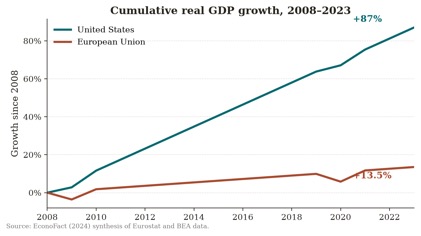
Figure 1. Cumulative real GDP growth, 2008–2023. Source: EconoFact synthesis of Eurostat and BEA data.
Europe is not the future Mr. Carney says it is. It is the cautionary tale. It is the developed world’s leading illustration of what happens to a continent that regulates rather than builds, litigates rather than innovates, borrows rather than earns, and pays the price in demographic contraction, energy dependency, industrial decline, and youth unemployment. This is the “partner” for whom Mr. Carney has walked away from the country that buys three of every four things we make.
Meanwhile, an American reindustrialization
While the European Union has been drafting the Digital Markets Act (DMA), the Digital Services Act (DSA), the General Data Protection Regulation (GDPR), the Artificial Intelligence Act (AI Act), and the Carbon Border Adjustment Mechanism (CBAM) — every one of them a regulation, not a factory — the United States has been busy at the more difficult work of building things. The Creating Helpful Incentives to Produce Semiconductors and Science Act (CHIPS and Science Act, 2022), the Inflation Reduction Act (IRA, 2022), and the Trump-era tariff wall have anchored the largest wave of American industrial investment since the Second World War.
- Over US$500 billion in announced private semiconductor investment.
- More than 100 projects across 28 states.
- U.S. domestic chipmaking capacity on track to roughly triple by 2032.
- Multi-decade highs in manufacturing construction spending across automotive, battery, liquefied natural gas (LNG), and heavy industry.
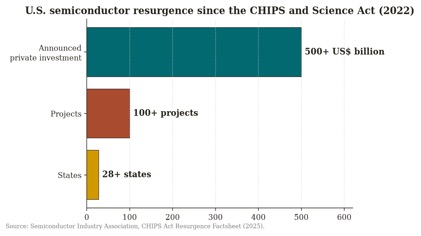
Figure 2. U.S. semiconductor resurgence since the CHIPS and Science Act (2022). Source: Semiconductor Industry Association (2025).
This is the economy on our southern border. It is the largest, richest, freest, most innovative market on earth. Canada, a country whose exports are 75.9 percent destined for that market, has a Prime Minister who has walked away from its negotiating table and travelled to Strasbourg to court a stagnating alternative.
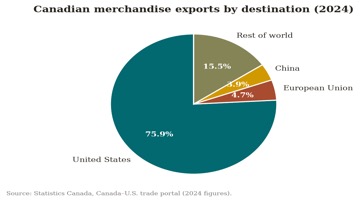
Figure 3. Canadian merchandise exports by destination (2024). Source: Statistics Canada.
Reagan warned us where this ends:
In this present crisis, government is not the solution to our problem; government is the problem.
— Ronald Reagan, First Inaugural Address, 20 January 1981.
Canada’s problem is not the United States. It is us.
The pivot to Brussels is being sold as a response to Donald Trump. It is not. It is a response to the fact that a decade of Liberal government has left this country structurally uncompetitive, and Mr. Carney has no plan to fix that, only a plan to hide it behind a European flag.
- Canadian labour productivity growth has fallen from an annual 3.7 percent in the 1947–1973 era to an annual 1.7 percent through the late twentieth century to under 1 percent since 2000.
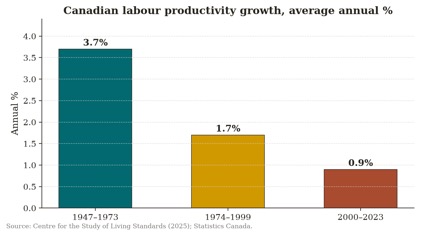
Figure 4. Canadian labour productivity growth, average annual %. Source: Centre for the Study of Living Standards (2025).
- Canadian real GDP per capita fell for six consecutive quarters into the third quarter of 2024, one of the deepest and longest per-person contractions in the developed world.
- Population growth engineered through record immigration has masked what is, on a per-person basis, a decade of stagnation.
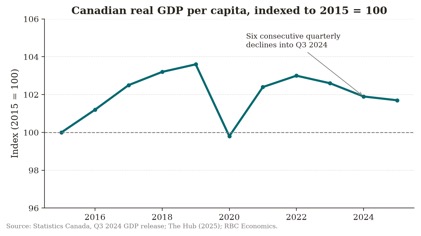
Figure 5. Canadian real GDP per capita, indexed to 2015 = 100. Source: Statistics Canada Q3 2024 GDP release.
Enoch Powell, whatever else his sins, was right about the constitutional condition precedent to any relationship with Brussels:
The decisive step of accession to the Community must be conditional on the full-hearted consent of parliament and people.
— Enoch Powell, House of Commons, 17 February 1972.
The full-hearted consent of Parliament and people has not been sought, will not be sought if Mr. Carney can avoid it, and is precisely the sort of tiresome democratic irritation his career has been organized to route around.
The changing story of the walkout
On the night of 21 August 2026, the Prime Minister suspended trade negotiations with the United States and recalled our negotiators from Washington. The explanations have been, to put it charitably, a moving target.
- Friday night, 21 August: the American proposals were “unfair”, “uneconomic”, and “called into question the reliability of any deal”.
- Saturday, 22 August: the Americans “asked too much and offered too little”.
- Same day, 22 August: it was about auto content, medium- and heavy-duty trucks, French-language protections, and Canada’s ability to sign trade deals with third parties.
- Monday, 24 August: it was really about protecting the French language.
- 26 August: we had been “attacked”.
- 1 September: the Americans wanted to make Canadian industry into “subsidiaries” or “wipe it out”.
- 3 September: the Prime Minister dismissed the American explanations as coming from “unelected” officials — a curious epithet from a man who had never sat as an elected Member of Parliament in his life prior to becoming Prime Minister.
Every one of these explanations may contain some element of truth. But taken together, they are the story of a man manufacturing a rationale after the fact, because the actual reason for the walkout was that the pivot to Brussels was already in motion. The Wall Street Journal had confirmed, by 13 September, that Mr. Carney had directed his special envoy to Europe to scope the “most ambitious possibilities short of full membership”. This work did not begin after the American negotiations broke down, it preceded them.
Canadians were not told the truth. We were told stories. Different stories on different days for different audiences.
Who profits from the pivot?
Every pivot has beneficiaries, and Canadians should ask, loudly and repeatedly, cui bono? Whose interests are aligned with the associate-membership project? Whose bank accounts, whose portfolios, whose consulting invoices, whose regulatory rents?
The globalist consultancy class
Under the Trudeau-Carney continuum, McKinsey & Company saw its federal contracts rise thirtyfold over the Harper baseline, culminating in the Auditor General’s finding that Ottawa had “flouted proper contracting policies” and could not demonstrate value for money on $209 million in McKinsey work. Deloitte, Accenture, KPMG, PwC, and Boston Consulting Group have all fed at the same trough. An associate-membership regime — with its endless “harmonization” tables, its “regulatory alignment” workstreams, its ESG-taxonomy translation exercises, and its perpetual Brussels-Ottawa reconciliation — is a ten-year consulting billing bonanza. It is a full-employment programme for the professional-managerial class of Ottawa, Toronto, Brussels, and Davos.
The green-finance complex
Mr. Carney did not spend a decade building the Glasgow Financial Alliance for Net Zero, chairing Brookfield’s ESG and Transition Investing platforms, and drafting the UN’s climate-finance framework as a hobby. He built a capital-allocation architecture. That architecture requires jurisdictions willing to embed its taxonomies, its disclosure regimes, and its regulatory tilts into domestic law. EU rules (the Corporate Sustainability Reporting Directive, the Sustainable Finance Disclosure Regulation, and CBAM) are the finished article. Associate membership is how you import them without a domestic legislative fight. The beneficiaries are the funds, the fund managers, the transition-financing intermediaries, and the ESG-compliance industry, which happens to be the industry Mr. Carney is most personally identified with in the world.
The Laurentian courtier class
Gerald Butts, Justin Trudeau’s principal secretary, architect of the carbon tax, chief author of the “post-national state,” has since 2018 been Vice Chairman of the Eurasia Group, the political-risk consultancy run by Ian Bremmer. Mark Carney and Gerald Butts have moved in the same institutional orbits for two decades. When you understand that the Eurasia Group’s core product is pricing sovereign-risk to global capital, and that the Ottawa-Brussels alignment project is precisely the sort of complex, multi-year, multi-jurisdictional file that a firm like Eurasia bills against for a decade, the picture clarifies itself.
Quebec’s supply-managed dairy oligopoly
Under CETA, Ottawa carved out protections for supply-managed dairy. Quebec’s roughly 4,200 dairy farms — commanding 37 percent of national output while the western provinces are capped at 16 percent — have been political untouchables under every Liberal government of the modern era. It is not accidental that among the three “red lines” that reportedly killed the American negotiation was the protection of French-language rules and, by extension, the cultural-policy architecture that shields Quebec’s dairy oligopoly from consumer choice. Watch the associate-membership file carefully: Quebec’s protected sectors will emerge intact.
Bay Street’s regulatory-arbitrage layer
The tax lawyers, the securities lawyers, the compliance officers, the ESG consultants, and the professional-services partnerships that make their living navigating overlapping regulatory regimes will do very well indeed out of a Canada with one foot in North America and one foot in Brussels. Complexity is a business model, and this is complexity by the shipload.
Who loses
- Alberta and Saskatchewan. The energy sector that has funded transfer payments for two generations. Every European regulatory framework Mr. Carney admires is hostile to Canadian oil, Canadian gas, Canadian LNG, and Canadian pipelines. The CBAM alone is designed to tax exactly what Alberta produces.
- Ontario’s automotive corridor. Deep alignment with EU standards means divergence from the U.S. standards that govern the assembly plants in Windsor, Oshawa, Cambridge, Ingersoll, and Oakville — plants whose supply chains cross the American border thousands of times a year.
- Manitoba, Saskatchewan, and Alberta’s grain and livestock farmers. They will keep facing EU non-tariff barriers on hormones, genetically modified crops, and animal welfare that no “associate membership” will remove, while their dairy competitors in Quebec keep their walled garden.
- The Canadian small-business owner and the incorporated professional. They already labour under a top marginal integrated rate of tax that exceeds fifty percent, an interprovincial trade wall the Organisation for Economic Co-operation and Development (OECD) ranks among the worst in the developed world, and a regulatory apparatus that has strangled a generation of entrepreneurship. To this they are now asked to add Brussels’ regulatory perimeter.
- The Canadian voter. Because none of this has been put to them.
Churchill saw the shape of it a century ago, and it holds:
But we have our own dream and our own task. We are with Europe, but not of it. We are linked, but not comprised. We are interested and associated, but not absorbed.
— Winston S. Churchill, Saturday Evening Post, 15 February 1930.
Churchill’s “associated but not absorbed” is the honest formulation. Mr. Carney’s associate member is the dishonest one, precisely because he cannot tell you where the association ends and the absorption begins — and he does not want to.
Carney’s contempt for Parliament
Every step of this file has been executed as a fait accompli, presented to Parliament and to Canadians after the fact, and defended with the technocrat’s usual mixture of vague reassurance and impatient condescension. There has been:
- No treaty text.
- No costed impact analysis.
- No white paper.
- No consultation with the provinces on areas of exclusive or concurrent jurisdiction, including securities, resource development, agriculture, culture, and education.
- No indication of whether Parliament will be given a vote before Canadian negotiators sign anything.
- No indication of whether the Canadian people will be given a referendum on a change to our external relations that in scope and effect is of constitutional character.
This is not new. It is, in fact, the through-line of the Carney premiership. He governs by summit, statement, and press availability. He inherited a prorogation still under Federal Court of Appeal challenge and publicly denied ever contemplating another one — while retaining every prerogative to invoke it. He has never sat as an elected MP before his elevation; his prior career is exhaustively institutional and central-banking, as in the Bank of Canada, the Bank of England, the FSB, the G30, the UN Special Envoy role, Brookfield, GFANZ. Every one of those institutions is designed to insulate decision-making from parliamentary and electoral accountability. That is not a bug on his résumé. It is the résumé.
The fundamental Liberal continuity
Canadians who supported Mr. Carney in the belief that he represented a break from the Trudeau decade have been misled. He was Justin Trudeau’s principal economic adviser through the most destructive five years of that government. He has retained Chrystia Freeland’s fiscal architecture in all its essential contours. He has kept the emissions cap in modified form, kept the industrial carbon regime, kept the interprovincial trade wall, kept the equalization arithmetic, kept the bureaucracy — a 40 percent expansion under Trudeau — and now proposes to import the European Union’s regulatory operating system on top of it.
The consumer carbon tax was scrapped for optics. The capital-gains inclusion rate increase was scrapped for optics. The Productivity Mega-Deduction announced on 15 September 2026, welcome as it is, is a tacit confession that everything the government did between 2015 and 2026 made this country uninvestable. It does not undo the damage. It merely reduces the marginal effective tax rate (METR) on new investment from roughly 13 percent to 6.4 percent — a good measure that arrives after a decade of the opposite policy from the same political movement.
This is not reform. This is the same Liberal Party rearranging the deck chairs on the same ship, painting Brussels stars on the hull, and telling Canadians the iceberg is our fault for standing too close to America.
What Canadians should ask, plainly
- What does associate membership mean, in law? Show us the treaty text — before, not after.
- Which chapters of the acquis communautaire will Canada adopt? Agriculture? Financial services? Digital? Environmental? Labour? Immigration?
- Who arbitrates disputes? The Court of Justice of the European Union (CJEU)? A joint body? Canadian courts? On which subject-matters is the sovereignty of Parliament ceded?
- Will there be an election on this, a referendum, or neither?
- Given Mr. Carney’s 2016 Brexit warnings — systematically wrong on direction and magnitude — what accountability does he offer for asking Canadians to trust his EU judgement in 2026?
- Which industries, professions, and regions gain? Which lose? Where is the sectoral impact study?
- What is the disposition of our relationship with the United States (the market that buys three of every four Canadian goods) while this alignment proceeds?
- Why should a Prime Minister who declined to release a fully costed election platform be trusted to disclose the true cost of a treaty relationship of this magnitude?
The bottom line
Canada’s problem is not that we are too close to the United States. Canada’s problem is that fifty years of policy, accelerated dramatically in the last ten, has made us uncompetitive within North America. The rational response is to fix Canada: cut marginal rates, dismantle interprovincial trade barriers, approve the energy corridor, restore capital-formation incentives, rein in the federal payroll, and rationalize regulation with the largest, richest, fastest-growing developed economy on earth: the one on our southern border.
Mr. Carney’s response is to import the regulatory framework of a slower, older, poorer, more indebted, more bureaucratic bloc — while walking away from the negotiating table with the country that buys three of every four things we make. He is doing so without a mandate, without a treaty text, without a costed impact study, without the consent of Parliament, and without the full-hearted consent — Powell’s phrase, and it is the right one — of the Canadian people.
He is doing so because his entire career has been organized around the proposition that democratic self-government is inferior to expert supranational governance. He was wrong about that in Britain in 2016. He is wrong about it in Canada in 2026.
Free trade with Europe? We have that. It is called CETA and it has been in force for nine years. What Mr. Carney proposes is different in kind. It is undefined, undemocratic, unratified, and arguably a fourth term of a government the country intended to retire.
Leviathan must be stopped.
But we have our own dream and our own task. We are with Europe, but not of it. We are linked, but not comprised. We are interested and associated, but not absorbed.
— Winston S. Churchill, 1930. It was good counsel for Britain then. It is good counsel for Canada now.
Trevor R. Parry, M.A., LL.B., LL.M. (Tax), CLU, TEP, Barrister & Solicitor