
The Liberal Immigration Record, 2015 to 2026, and a Habit of Governing Without Disclosure or Consent
Trevor R. Parry | November 21, 2026
I. A Supporter’s Candour
Let me state at the outset that I am, and have always been, a supporter of immigration. Canada’s long record of successful immigration has never been the work of newcomers alone. It has been the work of established Canadian communities, in places like Sudbury, Brooks and London as much as in Toronto and Montreal, that were welcoming and tolerant enough to make room, working together with newcomers who were willing to join them. My own practice, my community in Ancaster and Hamilton, and the clients I am privileged to serve are living proof that people who arrive with ambition and a willingness to work make this country stronger. The great majority of those who have come in the last decade are hard-working, law-abiding and accretive to Canada. They pay their taxes, start businesses, raise families and, in many cases, display a reverence for this country’s institutions that native-born Canadians have allowed to lapse. Nothing in this paper should be read as an argument about race, religion or ancestry. It is an argument about numbers, pace, administration, the rule of law and democratic consent.
It is worth recording, too, that despite nearly four decades of official multiculturalism, under a statute whose long title commits Parliament to “the preservation and enhancement of multiculturalism in Canada,”[1] newcomers have, for the most part, found themselves becoming part of Canadian culture and society rather than living apart from it. The best evidence is on the ice. Hockey is, by Act of Parliament, the national winter sport of Canada,[2] and it is now played at the highest level by the sons and grandsons of immigrants from every corner of the world. When Karl Subban arrived in Sudbury from Jamaica as a boy, he found that his new neighbours neither looked like him nor spoke his language; he began playing street hockey with the French-speaking children on his street, became a devoted Canadiens fan, and passed that devotion to his son, P.K., who was drafted by Montreal and won the Norris Trophy in 2013.[3] P.K.’s mother came to Hamilton from Montserrat.[4] Jarome Iginla, whose father arrived from Nigeria and changed his name from Adekunle to Elvis, captained the Calgary Flames and entered the Hockey Hall of Fame.[5] Nazem Kadri, whose grandfather left Lebanon for London, Ontario, in the 1960s, became the first Muslim player to win the Stanley Cup in 2022, and began his day with the Cup at the London Muslim Mosque before a parade through his hometown.[6] For eighteen years, Hockey Night in Canada: Punjabi Edition brought the game into Punjabi-speaking homes, and its broadcasters report that parents began enrolling their children once they could follow the play.[7] These players are dedicated to the game and to their teams. That is what integration looks like when it works: not the erasure of heritage, but its happy subordination to a common loyalty, freely given.
Douglas Murray, in The Madness of Crowds, describes the opposite tendency. Identity politics, he writes, “atomizes society into different interest groups” and “presumes that such characteristics are the main, or only, relevant attributes of their holders.”[8] Speaking about the book, he put the alternative plainly: the old aspiration was to judge people “by the content of their character,” whereas a politics built on inherited characteristics means that “we are all prisoners of how we were born.”[9] The hockey dressing room has never accepted that premise; it cares whether you back-check. My concern in this paper is that the policies of the last decade have strained the very conditions, of pace, scale and shared expectation, that allowed that kind of integration to happen.
It is precisely because I hold those views that the present situation demands candour. Over eleven years, a system once admired around the world for its discipline has been converted into something its architects would not recognise: a mechanism for supplying low-wage labour to employers, for inflating aggregate growth while per-person prosperity declines, and for pursuing a demographic project that no Canadian government has ever placed before the electorate. Prime Minister Carney himself has conceded that Canada admitted “much higher levels of foreign workers, students and new Canadians coming in than we could absorb,” adding that “we’re letting down the people that we let in, quite frankly.”[10] He called the Trudeau-era levels “far too high.”[11] Those admissions are the beginning of wisdom. They are not, however, a policy, and his government’s first full levels plan suggests that the lesson has been only partly learned.
My thesis is threefold. First, the Temporary Foreign Worker Program, conceived as a narrow exception, has morphed into a structural feature of the low-wage economy, and the first casualty has been the first job, that humble rung on which generations of young Canadians learned punctuality, responsibility and the dignity of earned wages. Second, the system has been abused by a minority of employers and exploited by criminal networks, and enforcement has lagged far behind both. Third, and most fundamentally, the scale and direction of change, including the population ambitions associated with the Century Initiative, have never been put to Canadians in a general election and are opposed by clear majorities. That is not an isolated lapse. It is part and parcel of a decade-long Liberal habit of non-disclosure: warnings withheld, documents refused to Parliament, Parliament itself suspended, and statutory deadlines set aside. It reflects a style of governing that treats Parliament and the electorate as obstacles rather than masters. The premise of the whole enterprise has been that more is better: more people, more workers, more aggregate growth. More is not necessarily better, and Canadians were never asked.
II. What the Program Was Meant to Be
Fairness requires context. Canada’s use of temporary labour began modestly and sensibly. The Seasonal Agricultural Worker Program was launched in 1966 to meet the peculiar rhythms of farm labour, and the broader Temporary Foreign Worker Program followed in 1973.[12] The 1973 Non-Immigrant Employment Authorization Program was designed for “highly specialized” workers, the visiting engineer or academic whose skills could not be found in Canada, and it tied workers to particular employers precisely because each admission was meant to fill a specific, demonstrated gap.[13] The federal government’s own account of the program’s history describes it as created in 1973 “to bring in highly skilled workers.”[14]
The governing principle was stated plainly and repeated by ministers of both parties for decades: the program was to be a “last and limited resort,” available only when an employer could demonstrate that no Canadian or permanent resident was available to do the work.[15] That principle was not mere rhetoric. It reflected a moral judgement embedded in our labour-market institutions, that a Canadian employer’s first obligation is to the Canadian worker, and that importing labour on a temporary basis is a concession to necessity, not a business model.
Cicero wrote that salus populi suprema lex esto, the welfare of the people shall be the supreme law. For a labour-market program, the welfare of the people means, first, the welfare of those already here and looking for work.
III. The Morphing
The transformation came in stages, and fairness requires acknowledging that no party is blameless.
In 2002, the Chrétien government opened the program to lower-skilled occupations through a pilot project.[16] What began as an exception for specialists became a channel for general labour. The number of temporary foreign workers in Canada rose from about 101,000 in 2002 to about 338,000 in 2012.[17] The Harper government expanded the low-skill stream and, in 2007, introduced an Expedited Labour Market Opinion pilot that accelerated approvals.[18] By 2013 the program had reached a peak of some 162,400 approved positions.[19]
Then came a scandal and a reckoning. In April 2014, after reports that restaurants were displacing Canadian staff, Employment Minister Jason Kenney imposed a moratorium on the food-services sector, declaring that the program must be “a last and limited resort” and warning that employers “who are found to have lied” on applications “could face potential criminal prosecution.”[20] The chief executive of McDonald’s Canada was recorded describing the controversy as “bullshit.”[21] The government’s June 2014 overhaul promised to “restore” the program “to its original purpose,” split it into the Temporary Foreign Worker Program and a new International Mobility Program, and imposed caps on low-wage hiring.[22] The effect was immediate. Positive Labour Market Impact Assessments for low-wage positions fell from 47,305 in 2012 to 9,977 in 2015.[23] The reforms worked, which is the most damning fact of all, because it proves that the subsequent surge was a policy choice, not an inevitability.
The Trudeau government made that choice. In April 2022, under Employment Minister Carla Qualtrough, the Workforce Solutions Road Map raised the cap on low-wage temporary workers from 10% to 20% of a workplace, and to 30% in sectors including accommodation and food services; extended the validity of an assessment from nine to eighteen months; and abolished the long-standing policy of refusing to process low-wage applications in regions where unemployment exceeded 6%.[24] The measures were extended in 2023.[25] Approved positions more than doubled, from 108,988 in 2018 to 239,646 in 2023.[26]
The more consequential change, however, occurred outside the Temporary Foreign Worker Program altogether. The International Mobility Program, which requires no labour market test at all, grew from about 261,600 permit holders at the end of 2015 to about 1,263,145 at the end of 2024, an increase of nearly fivefold.[27] The government’s own transition binder records that 80% of work permits issued in 2024 were under the International Mobility Program.[28] Some 90% of those permits are open, meaning that the holder may work for any employer in any occupation.[29] In plain terms, the labour market test that was the moral core of the original program now governs only a small minority of foreign workers in Canada. Statistics Canada estimates that the number of temporary foreign workers rose from 356,000 in 2011 to 845,000 in 2021, and that by the third quarter of 2024 there were 3 million non-permanent residents in the country.[30]
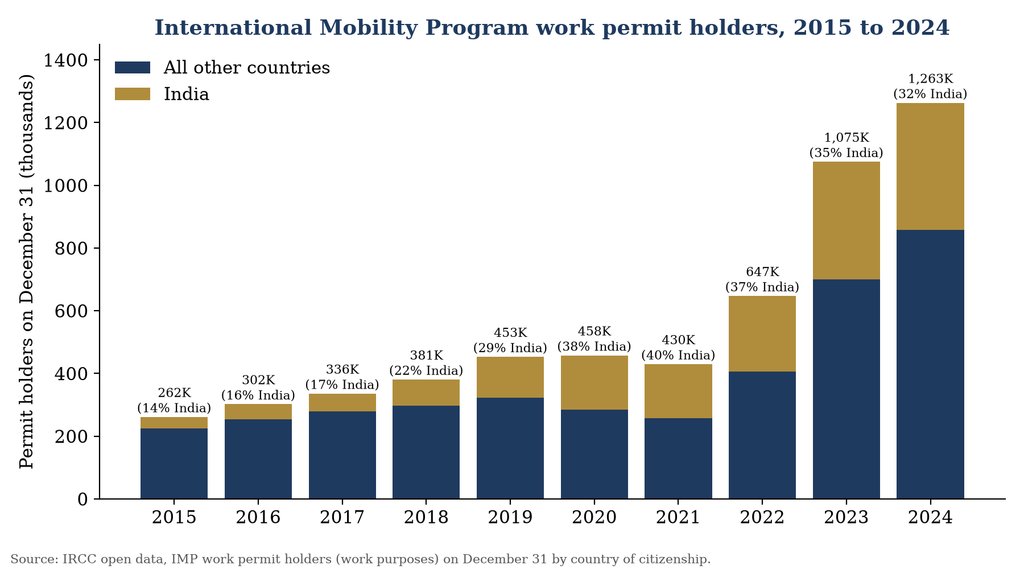
Figure 1. International Mobility Program work permit holders, 2015 to 2024
By March 2024 the government had begun to reverse course, lowering the cap and shortening validity periods.[31] The current rules restore a 10% low-wage cap, a one-year duration, and the refusal to process low-wage applications in metropolitan areas with unemployment at or above 6%.[32] In other words, after four years of experimentation, Ottawa has returned approximately to where Mr. Kenney left matters in 2014. The interval cost a generation of young workers their entry to the labour market. The Commons immigration committee itself recorded the principle that the program is “a last and limited resort,” and noted that new work permits had more than doubled since 2020.[33] Parliament was told what the program was for. The executive did otherwise.
IV. The First Job
Conservatives have always understood something that the managerial class too often forgets. A first job is not merely a source of income. It is an apprenticeship in adulthood. The sixteen-year-old behind the counter learns to arrive on time, to accept instruction, to be courteous to a difficult customer, to count change, and to understand that wages are earned and not given. Those habits compound over a lifetime. They are the private foundation of public virtue.
The evidence on what happens when that rung is removed is not ideological. Canadian research finds that poor labour market conditions at the start of a career “can depress earnings for several subsequent years.”[34] One study cited by Deloitte found that a six-month spell of unemployment at age 22 is associated with an 8% lower wage at 23, and wages remain two to three per cent lower even at ages 30 and 31.[35] Economists call this scarring. Parents call it a son who cannot leave home.
Youth unemployment rose from 10.0% in 2022 to 13.8% in 2025, which the Fraser Institute describes as an extraordinary increase outside a recession, attributing it in part to the rapid growth of immigrant labour supply.[36] By September 2025 the youth rate had reached 14.7%.[37] Economists who testified before the Commons human resources committee pointed to direct competition between young Canadians and temporary workers for entry-level work.[38] University of Waterloo economist Mikal Skuterud put it bluntly: the claim of labour shortages “really is a self-serving narrative mostly coming from corporate Canada,” and “we don’t like to think about this kind of competition, but of course it’s hard reality.”[39] Pierre Fortin has estimated that recent immigrant adults in Quebec’s labour force grew from about 135,000 in 2016 to about 500,000 in 2025.[40]
The occupational data are stark. Between 2018 and 2023, positions approved for food counter attendants rose from 170 to 8,333; for construction helpers and labourers from 132 to 5,353; for light duty cleaners from 201 to 3,043.[41] These are not jobs requiring rare skills. They are precisely the jobs on which Canadian teenagers, students and new entrants have always relied.
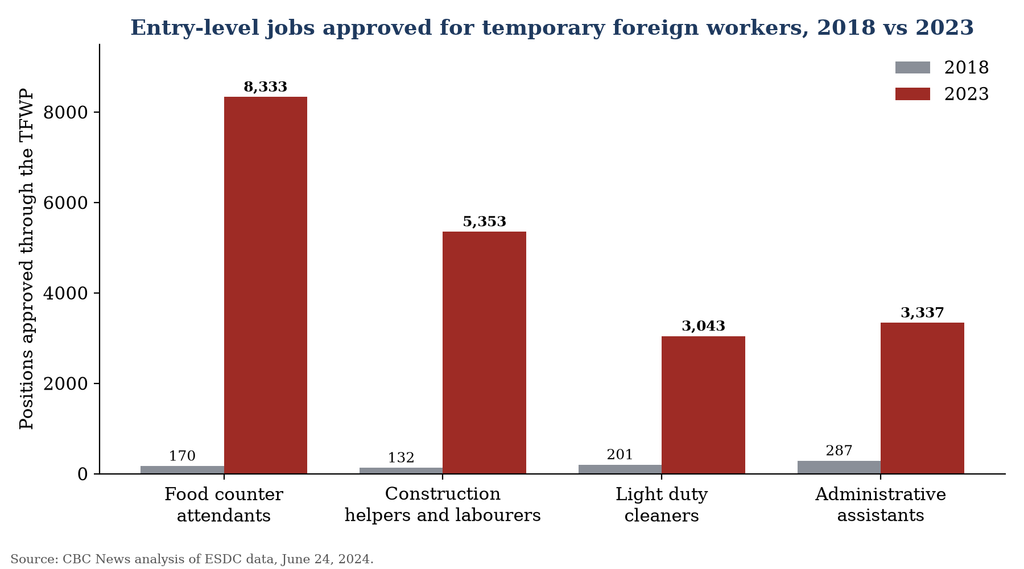
Figure 2. Entry-level jobs approved for temporary foreign workers, 2018 vs 2023
Charles Murray, whose broader work I do not adopt in every respect, made the essential point in a 2016 address on the American working class: low-skill immigration “deforms a great many of the processes that are required to make the free-enterprise, free-market system… work,” and “citizens of a nation owe something to each other.”[42] One need not accept every conclusion Murray has drawn to accept that one. The market depends on the price signal. When labour is scarce, wages rise, employers invest in training and productivity, and the young are hired because they must be. When the state supplies an elastic pool of foreign labour, that signal is muted, and the Canadian teenager is priced out by a worker who, through no fault of his own, is in no position to refuse.
There is a sobering macroeconomic corollary. The Fraser Institute has documented Canada’s “ugly” growth from 2020 to 2024, in which the overall economy grew while GDP per capita declined.[43] A country can grow larger and poorer at the same time. Aggregate growth flatters ministers. Per-capita growth feeds families.
V. Employer Abuse and the Failure of Enforcement
Most employers who use the program do so honestly and reluctantly. The system, however, has been designed in a way that invites abuse by the minority, and the federal government’s own auditors have said so repeatedly.
In 2017, the Auditor General found that the program was not working as a last resort. Officers did not sufficiently question employers’ claims in about 40% of cases examined, 65% of employers made no adequate effort to recruit from under-represented groups, and on-site inspections were few and, where they occurred, always announced in advance.[44] Commentary on the audit noted that some employers laid off Canadians while hiring temporary workers, and that only 13 of 173 planned on-site inspections had been completed.[45] In 2021, the Auditor General found problems in 73% of quarantine inspections in 2020 and 88% in 2021.[46] ESDC’s own follow-up audit found continuing compliance weaknesses.[47]
The United Nations Special Rapporteur on contemporary forms of slavery, Tomoya Obokata, described employer-specific work permits as “a breeding ground for contemporary forms of slavery.”[48] His final report concluded that the system “institutionalizes asymmetries of power.”[49] Fairness requires noting that Mr. Obokata later told the Commons committee that he “never said it was widespread or systemic.”[50] I accept that qualification, and it strengthens rather than weakens the point: a program meant to be a narrow exception should never have come within the field of vision of a United Nations rapporteur on slavery at all.
Worse still is the trade in Labour Market Impact Assessments themselves. A joint CBC and Investigative Journalism Foundation investigation found assessments being sold to foreign nationals for between 25,000 and 45,000 dollars, and documented a rise in suspicious online advertisements from 29 to 97.[51] The commodity being sold was not a job but a route to permanent residence, since an approved assessment once carried substantial points under Express Entry. Ottawa removed those points only in 2025.[52] The penalties available are real on paper, from 500 to 100,000 dollars per violation and up to one million dollars per year, but ESDC itself cannot prosecute.[53] Mr. Kenney’s 2014 warning that false applications could lead to criminal prosecution has rarely been made good.
The rule of law is not a slogan. It is the proposition that rules mean what they say and apply to everyone. A program whose central rule, the labour market test, can be purchased for cash, and whose inspectors announce their visits in advance, is not governed by law. It is governed by convenience.
VI. Fast Food and the Vanishing First Job
For two generations, the fast-food counter has been the front door to the Canadian labour market. It was where the fifteen-year-old earned her first paycheque and the university student paid his tuition, and it was also where the retired tradesman or the widow found a few shifts, some company and a modest supplement to a pension. The demographic facts bear out the image. Statistics Canada reports that 43.8% of employees in food services and drinking places are under 25, against 13.1% of all workers, and more than two-thirds are under 35.[54] Tim Hortons has said that about 45% of its own workers are aged 15 to 24.[55] No other sector of the economy is so closely tied to the first job.
What changed after 2019 was the composition of that workforce. Statistics Canada finds that the share of food services jobs held by non-permanent residents rose from 11.3% in 2019 to 20.8% in 2023, and in limited-service eating places, the industry’s term for fast food, from 13.0% to 25.2%.[56] In four years, one fast-food job in eight became one in four. Bloomberg’s analysis of federal data found that temporary foreign workers approved for food and retail jumped 211% between 2019 and 2023, that major restaurant and retail chains collectively formed the largest group of employers using the program for those roles, and that their reliance was impossible to quantify precisely because so many applications were filed under numbered companies.[57] CBC’s review of the same data found that the ten employers cleared to hire the most food counter attendants in 2023 “were all fast food operators.”[58]
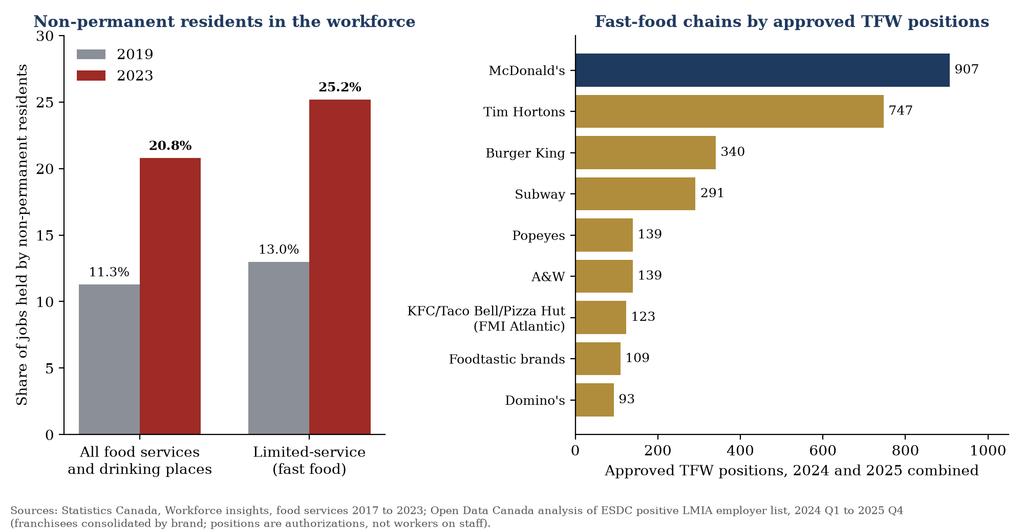
Figure 3. Fast food and the Temporary Foreign Worker Program
Have Young People and Seniors Been Harmed?
The question deserves an honest answer rather than a slogan, and the honest answer is that the evidence for young people is substantial, though causation remains contested, while the evidence for seniors is thinner and largely qualitative.
For young people, the trend lines are severe. The Centre for the Study of Living Standards reports that between the first quarter of 2023 and the second quarter of 2026, “the number of teenagers working in retail trade and accommodation and food services fell 18.2%,” while employment in those same industries among 20 to 24-year-olds holding bachelor’s degrees rose 54.3%; by mid-2026 the unemployment rate for 15 to 19-year-olds exceeded 20%.[59] The Canada West Foundation records youth unemployment rising from 10.3% in July 2023 to 14.6% in July 2025, and notes that economists suggest the 2022 changes to the Temporary Foreign Worker Program may be a factor, food service and counter positions still having a high proportion of temporary workers.[60] Bloomberg spoke to Alexander Clarke, seventeen, who had applied for months to grocery stores, fast-food restaurants and clothing shops without a reply: “A lot less youth are getting employed.”[61] Carleton economist Christopher Worswick, whose peer-reviewed work found that firms prefer temporary workers because they supply more effort for the same wage, put the economics plainly: “Labor shortages should be filled by wage increases,” and in allowing low-wage imports “we’re subsidizing those activities.”[62] Even the government’s own 2021 evaluation, which found no national evidence of displacement, acknowledged that “displacement may be occurring in some sectors,” naming the food industry among them.[63]
Fairness requires the counter-arguments. Immigration officials told the Commons committee in October 2025 that “a high proportion of temporary foreign workers does not necessarily correlate with a high youth unemployment rate.”[64] The CSLS itself attributes part of the deterioration to weak labour demand and to competition from new graduates, and cautions that it “could not distinguish temporary foreign workers from new graduates.”[65] I accept those qualifications. They do not, however, disturb the central point. In the industry that has always hired the young, the share of workers drawn from abroad doubled in four years while the number of teenagers employed fell by nearly a fifth. A conservative does not need a perfect regression to recognise that supply and demand still operate.
For seniors, the record is older and anecdotal. In 2014, CBC reported the case of Sandy Nelson, fifty-eight, who lost the serving job she had held for twenty-eight years at a Weyburn, Saskatchewan restaurant while temporary workers were retained; she had planned to retire from that job.[66] A co-worker who had trained her own replacements said: “The jobs they have aren’t jobs that nobody wanted. We wanted them.”[67] The Alberta Federation of Labour’s Gil McGowan argued the following year that “we need to save the first rungs of employment for new immigrants, students and seniors.”[68] The most careful academic study I have found, a 2013 University of British Columbia dissertation based on fieldwork in a global fast-food chain, concluded that while “aging, female (immigrant) workers, racialized workers and youth have historically been key suppliers of labour in the sector,” employers could “now circumvent these marginal segments of domestic labour pools by transnationally recruiting.”[69] I have found no national dataset that isolates the effect on older workers since 2019, and I would not claim more than the evidence supports. What the evidence does establish is that the retiree looking for part-time work and the teenager looking for a first job have always competed for the same counter, and that after 2022 the state added a third competitor who could not easily refuse.
What Tim Hortons Has Done
Because Tim Hortons is the brand most closely associated with this debate, it is worth setting out its record plainly and without embellishment.
The company has said that it “turned to” the program in 2021.[70] In May 2024, according to documents obtained under access to information, it wrote to then-Immigration Minister Marc Miller asking that the 20% cap on low-wage temporary workers be raised to 30%, seeking “flexibility in hiring TFWs.”[71] The Globe and Mail described the company as a “key proponent” of the expanded cap, and reported that federal lobbying records show it lobbied on the issue “through much of 2024 and 2025.”[72] In Ontario alone, Bloomberg found that Tim Hortons franchises were approved to hire at least 714 temporary foreign workers in 2023, up from 58 in 2019, about 92% of them under holding companies that did not bear the franchise name.[73] Litigation involving one Ontario franchisee disclosed that 41 of 156 employees were temporary foreign workers, and 19 of 23, about 83%, at a location in Alexandria, Ontario; HR Reporter properly cautioned that such figures do not, on their own, establish any breach of the rules, and I adopt that caution.[74]
In May 2026, the company announced a pledge to hire 10,000 local workers, stated that its roughly 4,000 temporary foreign workers represented about 3.6% of its Canadian workforce, and said that its use of the program had “gone down by 50 per cent from 2024.”[75] [76] Its communications director, Michael Oliveira, said: “We think one of the biggest misperceptions about Tim Hortons is how the TFW program has been used.”[77] The company also said that further lobbying was “no longer necessary.”[78] The pledge is welcome. It should be judged, as all such pledges should, by the hiring records of the franchises over the next several years.
Dunkin’ Returns
The timing of the Tim Hortons pledge is worth noting. Two weeks earlier, on May 12, 2026, the Montreal franchisor Foodtastic announced a master franchise agreement with Inspire Brands to bring Dunkin’ back to Canada, eight years after the chain left, with “hundreds” of locations planned and the first stores expected in Toronto and Montreal in late 2026 or early 2027.[79] Foodtastic’s chief executive, Peter Mammas, has spoken of 600 to 700 restaurants, close to 200 of them in Quebec.[80] He has presented the venture as a Canadian one: “Foodtastic is a Canadian company… we will operate it with franchise partners who are Canadians living in their own communities.”[81] He has said the company will franchise “to local operators; people who will own the Dunkin’ in their communities.”[82]
That is a promise about who will own the restaurants, and it is a welcome one. It is not yet a promise about who will work behind the counter. As of the end of May, the launch materials had not addressed how the Dunkin’ rollout would be staffed or whether franchisees would use the Temporary Foreign Worker Program.[83] The only available evidence is Foodtastic’s existing portfolio. Its franchisees across five core brands were approved for 109 temporary foreign worker positions in 2024 and 2025, almost all in low-wage food service roles, which works out to roughly 5.7 positions per 1,000 employees, against an estimated 6.8 at Tim Hortons.[84] Those figures rest on an estimate of Foodtastic’s workforce, since the company does not publish one, and the hiring decisions are made by individual franchisees rather than by head office.[85] If Dunkin’ wishes to win Canadians back, a few hundred new counters across Ontario and Quebec offer it a clear opportunity: a public commitment that the first job at a Dunkin’ will go first to a young Canadian or a retiree in the community. Canadians will judge Dunkin’, as they should judge Tim Hortons, by the hiring records.
The Largest Users of the Program
Tim Hortons is not the largest user of the Temporary Foreign Worker Program, and singling it out obscures the structure of the program. By a wide margin, the largest user is agriculture. In 2024, 36% of all approved positions were in the Primary Agriculture stream, and nearly 86,000 agricultural positions were approved; temporary workers now fill about 40% of the primary agriculture labour force.[86] Food, fish and meat processing accounted for roughly 12,000 further approved positions, and some 8,100 positions were approved for transport truck drivers.[87] [88] After farm and greenhouse workers, the occupations with the most approvals in 2023 were cooks, food service supervisors, food counter attendants and kitchen helpers.[89]
Within fast food, the leading user over 2024 and 2025 was not Tim Hortons. An analysis of the federal positive-LMIA employer list, consolidating franchisees that file under their own corporate names, found 907 approved positions across McDonald’s franchisees, 747 across Tim Hortons franchisees, 340 for Burger King, 291 for Subway, 139 each for Popeyes and A&W, 123 for the master franchisee of KFC, Taco Bell and Pizza Hut in Atlantic Canada, 109 across Foodtastic’s brands and 93 for Domino’s.[90] Measured against workforce, that is roughly 9.1 approved positions per 1,000 employees at McDonald’s and 6.8 at Tim Hortons.[91] Those figures are hiring authorizations rather than workers on staff, they exclude several hundred positions held by numbered companies that cannot be matched to a brand, and they cover a period after Ottawa cut the low-wage cap from 20% to 10% in September 2024, so they understate the peak years of 2022 and 2023.[92] [93]
The distinction between these users matters to a conservative. Seasonal agriculture is the use for which the program was designed in 1966, and the case that Canadians will not do that work at the wages that the market can bear has been made, and largely accepted, for sixty years. The fast-food counter is the opposite case. It is the one job that young Canadians and retirees have always been willing to do. The point is not that any one company is a villain. Firms respond to the incentives the state creates. When Ottawa opened the door in 2022, fast-food operators walked through it; when Ottawa narrowed it in 2024, approvals fell. That sequence is the clearest proof that the displacement of the first job was a policy choice, made in Ottawa, and never put to the people it affected.
VII. The Century Initiative: An Agenda Never Campaigned On
The Century Initiative is a registered charity that advocates growing Canada’s population to 100 million by 2100. It was founded by Dominic Barton, then global managing partner of McKinsey, and Mark Wiseman, a senior pension and investment executive; the idea reportedly took shape in 2011 at Mr. Barton’s Muskoka cottage.[94] I raise it not as a conspiracy but as a case study in influence, and the distinction matters. There is no evidence that the government formally adopted the 100 million target. There is ample evidence that the people who conceived it occupied positions of extraordinary access.
In 2016, the Advisory Council on Economic Growth, chaired by Mr. Barton and appointed by Finance Minister Bill Morneau, recommended raising permanent immigration to 450,000 a year.[95] Global News reported at the time that Innovation Minister Navdeep Bains urged business leaders to help sell the idea, acknowledging the prospect of “pushback.”[96] Radio-Canada later reported that an IRCC source described the council’s report as having been treated as a “foundational plan” for the department’s growth targets, and that the Century Initiative has been registered to lobby federal officials since 2021.[97] Mr. Barton was subsequently appointed Ambassador to China. By late 2022, the government had set a target of 500,000 permanent residents for 2025, exceeding even the council’s recommendation.
When the target became controversial, the government distanced itself. Immigration Minister Sean Fraser’s office stated that the government “n’a pas pour objectif” a population of 100 million, and that the Century Initiative’s targets “ne constituent pas la politique du gouvernement.”[98] I accept the denial as a statement of formal policy. Yet the trajectory of actual admissions tracked the Initiative’s advocacy far more closely than any promise ever made to voters.
The connection has not ended with Mr. Trudeau. Mr. Wiseman, a close friend of Prime Minister Carney, was among the earliest financial backers of Mr. Carney’s leadership bid, and has since been appointed Canada’s Ambassador to the United States.[99] Opposition parties raised pointed concerns about the appointment.[100] I make no allegation of impropriety in the appointment itself. I observe only that the most consequential demographic idea in modern Canadian history has been carried by a small circle of influential men, through advisory councils, lobbying registrations and personal friendships, and never through the ballot box.
Consider the platforms. No Liberal platform has ever asked Canadians to endorse a population of 100 million. The 2025 Liberal platform promised the opposite: to “stabilize permanent admissions” at “less than 1% of Canada’s population annually beyond 2027” and to reduce temporary residents to below 5% of the population by the end of 2027.[101] It conceded that if Canada could not meet its responsibilities to newcomers, “we need to adjust the numbers.”[102] Eighteen months later, Budget 2026 and the accompanying levels plan provide for 380,000 permanent residents and 370,000 temporary arrivals, plus up to 200,000 one-time transitions of temporary residents to permanent status.[103] Commentators reading the same documents put the true 2027 permanent figure at up to 580,000, and as high as about 660,000 once earlier one-time programs are included.[104] The word “beyond” in the platform is doing considerable work.
Canadians, when asked, are clear. A Leger poll conducted in April 2023 found that only 13% of Canadians thought growing the population to 100 million by 2100 was a good idea, while 60% thought it was a bad idea, and 76% said it would worsen housing affordability.[105] A Leger survey in November 2022 found 58% saying that 500,000 immigrants a year was too many.[106]
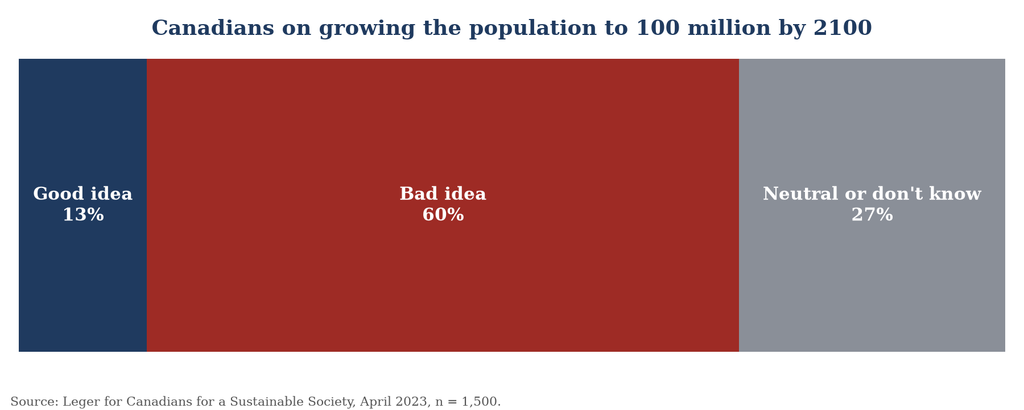
Figure 4. Canadians on the 100 million target
Justin Trudeau told The New York Times Magazine in 2015 that “There is no core identity, no mainstream in Canada,” and that this made Canada “the first post-national state.”[107] That was, at least, a candid statement of philosophy. But a philosophy announced to a foreign magazine is not a mandate from the Canadian people.
VIII. Bigger Is Not Richer: The Productivity Alternative
The economic case for the Century Initiative, and for the levels plans that followed it, rests on a simple proposition: more people, more growth. In a narrow arithmetic sense it is true. Add workers and total output rises. But aggregate GDP measures the size of an economy, not the prosperity of the people who live in it. The Waterloo labour economist Mikal Skuterud has put the point with textbook clarity: “the thing we should care about is GDP per capita,” and there is “no necessary relationship between population growth, whether it’s positive or negative, and growth in real GDP per capita, which is what economists call economic growth.”[108] The government’s own research arm reached a similar conclusion years ago. A research paper published by IRCC found that, “to the extent that a research consensus exists, it suggests that immigration has a small, or no, effect on GDP per capita, the wages of the domestic-born, and the fiscal balance.”[109] Skuterud and his co-authors concluded in 2024 that “Canada is not well-positioned to leverage heightened immigration to boost GDP per capita owing primarily to weak capital investment.”[110]
There is another road to growth, and it is the one every prosperous nation has travelled. Paul Krugman, no conservative, wrote the line that every economics student learns: “Productivity isn’t everything, but in the long run it is almost everything.”[111] He explained why: “A country’s ability to improve its standard of living over time depends almost entirely on its ability to raise its output per worker.”[112] Growth that comes from more output per hour is growth that every existing Canadian, and every newcomer, shares. Growth that comes only from more hours worked by more people is growth that must be divided among more mouths.
On that measure, Canada is in trouble, and the warnings have come from the most sober institution in the country. In March 2024, Senior Deputy Governor Carolyn Rogers of the Bank of Canada told a Halifax audience: “You’ve seen those signs that say, ‘In emergency, break glass.’ Well, it’s time to break the glass.”[113] She noted that in 1984 Canada produced 88% of the value generated per hour in the United States, and that “by 2022, Canadian productivity had fallen to just 71% of that of the United States.”[114] Governor Tiff Macklem followed with a diagnosis that might serve as an epitaph for the decade: “Our Achilles heel is productivity. We have been very good at growing our economy by adding workers. We have been much less successful at increasing output per worker.” He added that “with an aging population and limits to how many immigrants we can successfully absorb each year, improving our productivity growth will become more important.”[115]
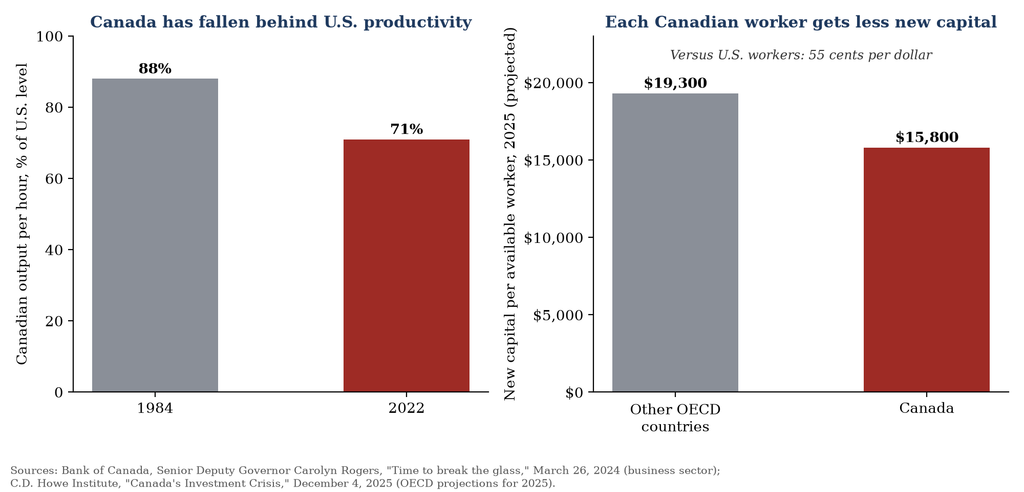
Figure 5. Productivity and capital per worker
The mechanism is not mysterious. Output per worker depends heavily on the tools each worker has, and Statistics Canada reports that fixed capital invested per worker “was the most important source of labour productivity growth over the past 30 years,” yet by 2021 investment per worker in the business sector was about 15% lower than in 2006.[116] The C.D. Howe Institute found that “business investment in Canada has been so weak since 2015 that capital per member of the workforce is falling,” that a Canadian worker would receive in 2025 only 55 cents of new capital for every dollar received by an American, and that “low business investment and fast workforce growth are leading Canada down a labour-intensive path.”[117] When the workforce grows faster than the capital stock, each worker’s share of machinery, technology and know-how shrinks. That is how a country grows larger and poorer at the same time, as the Fraser Institute documented for 2020 to 2024.[118] The OECD projects that, without policy change, Canada could experience the slowest growth in real GDP per capita among advanced economies from 2020 to 2060.[119]
The Temporary Foreign Worker Program sits at the centre of this problem. An employer who can obtain low-wage labour on demand has little reason to buy the machine, redesign the process or train the worker. A review of the international literature by the Asian Productivity Organization found studies in which “immigration and automation act as substitutes, with a higher proportion of migrant workers in a local area leading firms to adopt fewer robots.”[120] Japan, facing a shrinking workforce far more severe than ours, took the other road. The OECD reports that “increasing productivity is the cornerstone of Japan’s policy to address labour shortages,” and that 60.7% of Japanese small and medium-sized firms facing shortages were responding by training employees, automating or improving business processes.[121] Japan has not closed its doors, but it has asked its employers to invest first.
To its credit, the present government has acknowledged the problem. Budget 2025 introduced a “Productivity Super-Deduction,” a set of enhanced write-offs designed “to boost productivity and attract investment.”[122] The measure is welcome. But a tax incentive to buy a machine cannot do its work while a federal program offers the same employer an inexpensive worker instead. The two policies pull in opposite directions, and Canadians have not been told which the government expects to prevail.
Canada should explore the productivity road with the same seriousness it has given the population road. That would mean measuring success by GDP per capita and real wages rather than headline GDP; requiring every levels plan to publish its expected effect on GDP per capita, housing and capital per worker; tying low-wage TFW approvals to evidence that the employer has invested in automation and training; and treating business investment, competition and regulatory certainty as the national priorities the Bank of Canada says they are. As Ms. Rogers put it, “when a business gives workers better tools and better training, those workers can produce more.”[123] A nation grows richer not by adding hands, but by giving each pair of hands better tools. More is not necessarily better. Better is better.
IX. Concentration of Source Countries
A conservative case on immigration must be scrupulous here, and I intend to be. The concern is not with any nationality, faith or people. Indian Canadians are among the most successful, entrepreneurial and civically engaged communities in this country, and I count many among my clients and friends. The concern is structural: when a very large share of a nation’s intake is drawn from a single source within a compressed period, integration becomes harder for everyone, including the newcomers themselves, and the system becomes more vulnerable to fraud, exploitation and the importation of foreign quarrels.
The concentration is real. In 2025, India accounted for 25.1% of new permanent residents, roughly four times the next source country.[124] India’s share of study permit holders rose from 29% in 2018 to 39% in 2022 and 40.6% in 2023.[125] Among International Mobility Program work permit holders, the number of Indian nationals rose from about 36,760 in 2015 to about 404,670 in 2024.[126] India is also the largest single source of pending refugee claims, about 43,900 or 15% of the Immigration and Refugee Board’s inventory, with an acceptance rate of about 26% against 64% overall.[127] Among former international students who claimed asylum in 2024, India was the leading country of citizenship.[128] In 2025, of 114,520 asylum claims, Haiti accounted for 16% and India for 15%.[129]
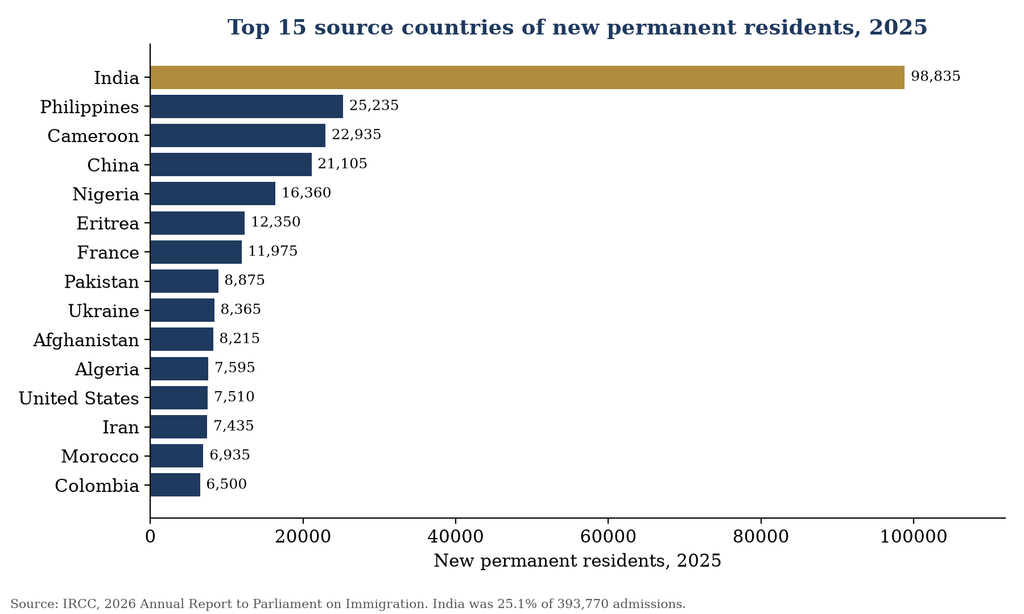
Figure 6. Top 15 source countries of new permanent residents, 2025
Paul Collier, the Oxford economist, argues in Exodus that the critical variable in migration policy is not the stock of newcomers but the rate at which diasporas are absorbed into the host society, and that rapid inflows from a single source slow that absorption.[130] The low acceptance rate of Indian asylum claims, alongside the flow of claims from former students, suggests that a material share of applicants has used the asylum system as an alternative route to permanence once study and work permits expired. That is not a criticism of India or Indians. It is a criticism of a system that made such routes predictable.
Quebec offers a parallel lesson of a different kind. A francophone society of under nine million people in an English-speaking continent cannot absorb a temporary population that grows faster than its capacity to teach French. Integration is not automatic. It is a civic achievement, and it has a speed limit.
X. The Criminal Element
The overwhelming majority of newcomers are law-abiding, and Statistics Canada’s research finds that immigrants are, on average, less likely to be accused of crime than the Canadian-born.[131] I accept that finding. But a system that admits people faster than it can screen them, adjudicates claims slowly and removes offenders rarely will inevitably allow a criminal minority to establish itself, and the victims are predominantly newcomers.
The most notorious case is the Lawrence Bishnoi gang. In October 2024, the RCMP took the extraordinary step of disclosing ongoing investigations into “the involvement of agents of the Government of India in serious criminal activity in Canada,” citing homicides, extortion and “the use of organized crime to create a perception of an unsafe environment targeting the South Asian Community.”[132] Assistant Commissioner Brigitte Gauvin named “the Bishnoi group,” saying “we believe that group is connected to agents of the Government of India.”[133] India has denied the allegations. In September 2025, the Government of Canada listed the Bishnoi gang as a terrorist entity, citing murder, shootings, arson and extortion in communities including Surrey, Brampton and Calgary.[134] In November 2026, American federal prosecutors charged Lawrence Bishnoi and associates in connection with organised crime including the 2023 killing of Hardeep Singh Nijjar in Surrey, though the RCMP stressed that those particular charges do not allege the involvement of Indian officials.[135]
The extortion wave is not limited to one organisation. The national police-reported extortion rate in 2025 was more than three times its level a decade earlier, 29 incidents per 100,000 against 9 in 2015.[136] In Peel Region, extortion incidents rose from 319 in 2023 to 494 in 2024 and 476 in 2025.[137] In May 2026, Peel police announced 17 arrests and 106 charges against a network calling itself For Brothers, linked to shootings involving 324 rounds fired at homes and businesses.[138] Police stated that the accused were in Canada either illegally or on immigration permits.[139] The Canada Border Services Agency reports more than 100 removals linked to its work against extortion networks.[140]
The victims of these networks are, overwhelmingly, South Asian Canadian business owners: the restaurateur, the trucking company operator, the jeweller who came here to escape exactly this kind of lawlessness. The first duty of the state is to protect them. A conservative immigration policy is not anti-immigrant. It is pro-immigrant in the most practical sense: it insists that those who come here lawfully should not be terrorised by those who came to exploit them.
Sweden is the cautionary tale. In 2023, Prime Minister Ulf Kristersson attributed a wave of gang violence to “irresponsible immigration policy and failed integration” and called in the armed forces to support police.[141] Canada is not Sweden. But Sweden was not Sweden either, until it was.
XI. The Wisdom of Those Who Warned
The case I am making is not new, and it is not the property of any one tradition. It has been made, with varying degrees of eloquence and tact, by thinkers across the democratic world.
Thomas Sowell, the great American economist, has written that “the purpose of immigration laws and policies is to serve the national interest of this country,” and that, unlike imported goods, “when you import people, you import cultures.”[142] He reminds us that cultures are “particular ways of accomplishing the things that make life possible,” and that they are neither interchangeable nor costless to transplant.[143] Sowell, the grandson of a slave and the most rigorous student of migration and culture of his generation, cannot be accused of animus. He is simply refusing to treat human beings as abstractions, observing drily that while we are “a nation of immigrants,” we are “also a nation of people who wear shoes.”[144]
David Goodhart, in The Road to Somewhere, distinguished between the “Anywheres,” mobile professionals who “comfortably surf social change,” and the “Somewheres,” rooted in place, who are “very hostile to large-scale immigration, although not necessarily to individual immigrants.”[145] That last clause is the heart of the matter, and it describes most Canadians.
Sir Roger Scruton coined the term oikophobia, “the repudiation of inheritance and home,” to describe the disposition of elites who feel more affinity for the abstract world than for their own nation.[146] G.K. Chesterton described tradition as “the democracy of the dead,” extending the franchise to our ancestors.[147] A conservative regards the country not as an economy with a flag but as a partnership, in Burke’s phrase, between the living, the dead and those yet to be born. Policy that reshapes that partnership at speed, without consent, is a breach of trust with all three.
Douglas Murray opened The Strange Death of Europe with the sentence “Europe is committing suicide. Or at least its leaders have decided to commit suicide.”[148] It remains to be seen if this is the case of Canada. But the second sentence deserves reflection: it locates the problem not in the people, nor in migrants, but in leadership.
The United Kingdom’s own Labour Prime Minister, Sir Keir Starmer, warned in 2025 that without control the country risked becoming “an island of strangers.”[149] When a Labour leader says it, the observation can no longer be dismissed as the preserve of the right.
Finally, John Gray of Oxford, a philosopher who belongs to no party and spares none, has offered perhaps the most penetrating diagnosis. In 2019 he wrote that “liberals are turning to law to entrench values and policies for which they cannot secure democratic assent,” and observed that working-class values are “deemed racist when… expressed as concern about continuing mass immigration.”[150] In 2025 he added, with characteristic severity, that “mass immigration was meant to result in conversion to liberal values. The opposite is happening.”[151] One need not share Gray’s pessimism to recognise the force of his first proposition. It describes Canada’s immigration policy precisely.
XII. Never Put to a Vote: A Pattern of Non-Disclosure
This brings me to the deepest objection, which is not economic but constitutional. In a parliamentary democracy, the people do not govern directly, but they are entitled to know the direction in which they are being governed and to approve or reject it at the next election. On immigration, that bargain has been broken.
The evidence of public opinion is unambiguous. Environics, which has tracked attitudes for decades, found that the share of Canadians saying there is too much immigration more than doubled, from 27% in 2022 to 58% in 2024, and that critics increasingly cite poor government management rather than newcomers themselves.[152] A Leger poll conducted in November 2026 found 56% saying Canada admits too many immigrants and 72% concerned about the 2027 increase, including 61% of Liberal voters.[153] Majorities of Canadians have rejected the 100 million ambition and the 500,000 target. No government has sought or received a mandate for either.
The failure to seek consent has been accompanied by a failure to disclose. In 2022, while the government was preparing the targets that would take permanent admissions to 500,000, its own officials warned the deputy minister that “population growth has exceeded the growth in available housing units” and that “rapid increases put pressure on health care and affordable housing”; they also noted that “increasing the working age population can have a positive impact on gross domestic product, but little effect on GDP per capita.”[154] Canadians learned of those warnings only in 2024, through an access to information request, long after the targets had been set.[155] A government that has been told that its policy will make housing less affordable and will do little for per-person prosperity, and that proceeds without telling the public, has not merely made a policy error. It has made a decision about what the public is entitled to know.
That decision fits a pattern. In 2021, when the House of Commons ordered the production of unredacted documents concerning the firing of two scientists at the National Microbiology Laboratory in Winnipeg, the government refused, and when the Speaker found a breach of the House’s privileges, the Attorney General took the Speaker of the House of Commons to the Federal Court to keep the documents from Parliament, abandoning the case only when Parliament was dissolved for an election.[156] In September 2024, Speaker Greg Fergus ruled that the House had “clearly ordered the production of certain documents” concerning Sustainable Development Technology Canada, “and that order has clearly not been fully complied with,” finding a prima facie breach of privilege; the House was paralysed for months.[157] In January 2025, rather than face the House, the Prime Minister advised the Governor General to prorogue Parliament until March 24, halting all bills, committee work and investigations.[158] Each episode can be defended on its own terms. Taken together, they describe a government that regards Parliament’s right to know as an inconvenience to be managed.
The process has mirrored the substance. The Immigration and Refugee Protection Act requires the Minister to table the annual immigration report, including the levels plan, by November 1.[159] This year the levels plan was folded into the federal budget and tabled after that date.[160] The statutory deadline is not a technicality. It exists so that Parliament can scrutinise the most consequential demographic decision the state makes each year as a discrete matter, rather than as a line in an omnibus fiscal document.
That episode is part of a pattern. Bill C-5 granted Cabinet sweeping authority to fast-track designated “national interest” projects, with limited parliamentary review.[161] Bill C-39 continued the approach.[162] Bill C-12 would give the Governor in Council power to cancel, suspend or vary immigration documents en masse on undefined “public interest” grounds, a breadth of discretion that legal practitioners and civil liberties groups alike have criticised for lacking individualised assessment and adequate oversight.[163] Whatever one thinks of the ends, the means share a common feature: authority flows from Parliament to Cabinet, and from Cabinet to officials, and the citizen is left to read about the results. Critics have begun to ask whether Parliament is becoming a “democracy theme park.”[164]
The Germans have a word, Rechtsstaat, for a state bound by law. The Romans had a phrase, mos maiorum, for the inherited customs that constrained even consuls. Mark Carney is a gifted technocrat, a man who has spent his life in central banks and boardrooms where the expert’s judgement is final. That background is admirable in a governor. It is less suited to a prime minister, whose authority rests not on expertise but on consent. A prime minister who promises “less than 1%” in April and delivers up to 1.5% eighteen months later, without seeking a fresh mandate, displays, at the very least, a disregard for the democratic process that has given him office.
XIII. What the Numbers Tell Us
- Low-wage TFWP approvals fell from 47,305 in 2012 to 9,977 in 2015 after the Kenney reforms, proving that restraint works.[165]
- Approved TFWP positions more than doubled, from 108,988 in 2018 to 239,646 in 2023, after the 2022 Road Map.[166]
- International Mobility Program permit holders grew nearly fivefold, from about 261,600 in 2015 to about 1,263,145 in 2024, with no labour market test.[167]
- Food counter attendant approvals rose from 170 in 2018 to 8,333 in 2023.[168]
- Youth unemployment rose from 10.0% in 2022 to 13.8% in 2025, reaching 14.7% in September 2025.[169] [170]
- In fast-food restaurants, the share of workers who were non-permanent residents nearly doubled, from 13.0% in 2019 to 25.2% in 2023, in an industry where 43.8% of employees are under 25.[171] [172]
- Teenage employment in retail and food services fell 18.2% between early 2023 and mid-2026.[173]
- Agriculture is the program’s largest user, with 36% of approved positions in 2024; in fast food, McDonald’s franchisees led with 907 approved positions in 2024 and 2025, followed by Tim Hortons at 747.[174] [175]
- Canadian business productivity fell from 88% of the U.S. level in 1984 to 71% in 2022, and a Canadian worker receives about 55 cents of new capital for every dollar received by an American.[176] [177]
- IRCC officials warned in 2022 that population growth was outpacing housing; the public learned of it in 2024.[178]
- LMIAs were sold for 25,000 to 45,000 dollars; ESDC cannot prosecute.[179] [180]
- India accounted for 25.1% of new permanent residents in 2025 and about 40% of study permit holders in 2023.[181] [182]
- The national extortion rate tripled in a decade, and the Bishnoi gang is now a listed terrorist entity.[183] [184]
- Only 13% of Canadians support a population of 100 million by 2100; 56% now say immigration is too high.[185] [186]
- No Liberal platform has ever sought a mandate for 100 million, 500,000 a year, or a 2027 intake of up to 580,000.[187] [188]
XIV. Conclusion: Restoring Consent
What would a conservative immigration policy look like? It would honour hard work by restoring the first job to young Canadians, returning the Temporary Foreign Worker Program to its original purpose as a last and limited resort and subjecting open work permits to a genuine labour market test. It would honour the rule of law by giving ESDC prosecutorial teeth, conducting unannounced inspections, removing offenders promptly and treating transnational extortion as the national security threat it is. It would honour tradition by setting levels that the country can absorb, from a broader range of source countries, at a pace that allows newcomers to become Canadians rather than residents of parallel communities. And it would honour democracy by placing the question squarely before the electorate: tabling the levels plan on time, as the statute requires, and asking Canadians, in a general election, whether they wish to become a nation of 100 million.
Festina lente, make haste slowly, was the motto of Augustus. It is sound counsel for any statesman entrusted with a nation’s future. Canada can welcome newcomers generously and still insist that they arrive at a pace and in a manner that the country has chosen. Those two commitments are not in tension. They are the same commitment, to a country worth joining, seen from both sides of the border.
The newcomer who works, saves and obeys the law deserves a functioning country. The young Canadian looking for a first job deserves a chance. And the Canadian voter deserves to be told the truth, and then to be asked. On all three counts, the system of the last decade has failed, and the government has yet to show that it understands why.
Trevor R. Parry, M.A., LL.B., LL.M. (Tax), CLU, TEP
Barrister & Solicitor
There remain but a few strategies for starving #Leviathan of tax, and but a few experts who can execute them.
#paylesstax
#taxlawyer
#LeviathanMustBeStopped
—
[1] Canadian Multiculturalism Act, R.S.C. 1985, c. 24 (4th Supp.), long title and s. 3(1)(a). https://laws-lois.justice.gc.ca/eng/acts/c-18.7/page-1.html
[2] National Sports of Canada Act, S.C. 1994, c. 16, s. 2. https://laws-lois.justice.gc.ca/eng/acts/n-16.7/page-1.html
[3] The Globe and Mail, “Canadiens’ playoff run fires up Francophone communities across the country.” https://www.theglobeandmail.com/canada/article-canadiens-stanley-cup-playoff-run-francophone-fans ; The Hockey Writers, “7 Things About P.K. Subban.” https://thehockeywriters.com/seven-things-about-pk-subban/
[4] Sportsnet, “P.K.: ‘It was the most special day of my life.’” https://www.sportsnet.ca/hockey/nhl/pk-subban-hockey-helpers-montreal-canadiens-malcolm-jordan/ ; Jamaicans.com, “Star National Hockey League Player of Jamaican Descent to Retire.” https://jamaicans.com/star-national-hockey-league-player-of-jamaican-descent-to-retire/
[5] Hockey Hall of Fame, “20/21 Induction Celebration: Jarome Iginla.” https://legends.hhof.com/induction/induction2021/jaromeiginla.html ; NHL.com, “Iginla inspired by Fuhr, will join him in Hockey Hall of Fame.” https://www.nhl.com/news/jarome-iginla-inspired-by-fellow-hockey-hall-of-famer-grant-fuhr-317256452
[6] Global News, “NHL star Nazem Kadri shares his story in new book.” https://globalnews.ca/news/10814810/nhl-player-nazem-kadri-new-book-legacy/ ; CBC News, “Nazem Kadri leads Stanley Cup parade in London, Ont., with mosque appearance.” https://www.cbc.ca/news/canada/london/nazem-kadri-leads-stanley-cup-parade-in-london-ont-with-mosque-appearance-1.6564409
[7] CBC News, “Hockey Night in Canada: Punjabi Edition not returning after 18 years.” https://www.cbc.ca/news/canada/hockey-night-in-canada-punjabi-hnic-9.7307537 ; ESPN, “How Punjabi broadcasters unite NHL fans.” https://www.espn.com/nhl/story/_/id/18115799/nhl-punjabi-tv-broadcasters-unite-fans-awesome-goal-calls-passion-hockey
[8] Douglas Murray, The Madness of Crowds: Gender, Race and Identity (London: Bloomsbury Continuum, 2019), quoted at Goodreads. https://www.goodreads.com/author/quotes/210682.Douglas_Murray?page=9
[9] American Enterprise Institute, “Video of the Day: Douglas Murray on the Danger of Identity Politics,” transcribing Murray’s remarks on The Madness of Crowds. https://www.aei.org/carpe-diem/video-of-the-day-douglas-murray-on-the-danger-of-identity-politics/
[10] The Canadian Press, “Canada didn’t live up to its values on immigration in recent years, Carney says,” Newmarket Today. https://www.newmarkettoday.ca/national-news/canada-didnt-live-up-to-its-values-on-immigration-in-recent-years-carney-says-9873656
[11] David Thomas, “Carney’s immigration plan looks a lot like Trudeau’s,” National Post via Yahoo News. https://ca.news.yahoo.com/david-thomas-carney-immigration-plan-110000078.html
[12] Employment and Social Development Canada, Evaluation of the Temporary Foreign Worker Program (2022). https://www.canada.ca/content/dam/esdc-edsc/documents/corporate/reports/evaluations/temporary-foreign-worker/SSPB-ED-TFWP-Report-PPTVersion-ENG-20220217-V08-Final-PPT_JP.pdf
[13] CBC News, “How Canada became addicted to temporary foreign workers.” https://cbc.ca/news/canada/how-canada-became-addicted-to-temporary-foreign-workers-1.2627572 ; CUPE, “Temporary Foreign Worker Program: The Facts.” https://cupe.ca/sites/cupe/files/emailing_tfwp_cupe_facts_lyx-v2.pdf
[14] Government of Canada, “Government of Canada overhauls Temporary Foreign Worker Program,” June 20, 2014. https://www.canada.ca/en/news/archive/2014/06/government-canada-overhauls-temporary-foreign-worker-program-ensuring-canadians-are-first-line-available-jobs.html
[15] House of Commons, Standing Committee on Citizenship and Immigration (CIMM), Report 21, 44th Parliament. https://www.ourcommons.ca/documentviewer/en/44-1/CIMM/report-21/page-96
[16] Government of Canada, note 14.
[17] CBC News, note 13.
[18] University of Melbourne, Centre for Employment and Labour Relations Law, Working Paper No. 45. https://law.unimelb.edu.au/__data/assets/pdf_file/0004/1649029/CELRL-Working-Paper-No.-45.pdf
[19] ESDC, note 12.
[20] Government of Canada, “Statement by the Honourable Jason Kenney, Minister of Employment and Social Development,” April 24, 2014. https://www.canada.ca/en/news/archive/2014/04/statement-honourable-jason-kenney-minister-employment-social-development-842269.html
[21] CBC News, “Temporary foreign worker program for fast-food sector suspended by Ottawa,” April 2014. http://www.cbc.ca/news/canada/british-columbia/temporary-foreign-worker-program-for-fast-food-sector-suspended-by-ottawa-1.2621385
[22] Government of Canada, note 14.
[23] ESDC, Temporary Foreign Worker Program 2012-2019, Annual Table 14, positive LMIAs by wage stream. https://www.edsc-esdc.gc.ca/ouvert-open/bca-seb/imt-lmi/TFWP2019_Annual_Table_14_e.csv
[24] ESDC, “Government of Canada announces Workforce Solutions Road Map,” April 4, 2022. https://www.canada.ca/en/employment-social-development/news/2022/04/government-of-canada-announces-workforce-solutions-road-map–further-changes-to-the-temporary-foreign-worker-program-to-address-labour-shortages-ac.html
[25] ESDC, “Government of Canada extends Workforce Solutions Road Map,” October 2023. https://www.canada.ca/en/employment-social-development/news/2023/10/government-of-canada-extends-workforce-solutions-road-map-and-introduces-new-wage-requirements-under-the-temporary-foreign-worker-program.html
[26] CBC News, “From fast food to construction, employers turn more and more to temporary foreign workers,” June 24, 2024. http://www.cbc.ca/lite/story/1.7240374
[27] IRCC open data, “International Mobility Program (IMP) work permit holders (for work purposes only) on December 31st by country of citizenship, 2000-2024.” https://www.ircc.canada.ca/opendata-donneesouvertes/data/en_odp_annual-tr-work-imp_citz_year_end.xlsx
[28] IRCC, Ministerial Transition Binder, “Temporary Workers,” May 2025. https://www.canada.ca/en/immigration-refugees-citizenship/corporate/transparency/transition-binders/minister-2025-05/temporary-workers.html
[29] HR Reporter, “Should 8 in 10 workers at a Tim Hortons franchise be temporary foreign workers?” October 2026. https://www.hrreporter.com/focus-areas/recruitment-and-staffing/should-8-in-10-workers-at-a-tim-hortons-franchise-be-temporary-foreign-workers/394965
[30] Statistics Canada, “Research to Insights: Temporary Foreign Workers in Canada.” https://www150.statcan.gc.ca/n1/pub/11-631-x/11-631-x2024006-eng.htm
[31] ESDC, “Government of Canada to adjust temporary measures under the Temporary Foreign Worker Program,” March 2024. https://www.canada.ca/en/employment-social-development/news/2024/03/government-of-canada-to-adjust-temporary-measures-under-the-temporary-foreign-worker-program-workforce-solutions-road-map.html
[32] IRCC, Deputy Minister Transition Binder 2026, “Temporary Workers.” https://www.canada.ca/en/immigration-refugees-citizenship/corporate/transparency/transition-binders/deputy-minister-2026/temporary-workers.html
[33] CIMM, Report 21, note 15; and https://www.ourcommons.ca/documentviewer/en/44-1/CIMM/report-21/page-24
[34] C.D. Howe Institute, “A Foot in the Door: The Ever-Changing Challenges of Youth Unemployment in Canada.” https://cdhowe.org/publication/a-foot-in-the-door-the-ever-changing-challenges-of-youth-unemployment-in-canada/
[35] Deloitte for The King’s Trust Canada, “Failure to Launch: The Economic and Social Costs of Youth Unemployment” (2024). https://www.kingstrust.ca/wp-content/uploads/2024/11/TKTC-Deloitte-Report-Failure-to-Launch-Final-1.pdf
[36] Fraser Institute, “The Extraordinary Increase of Youth Unemployment in Canada,” April 2026. https://www.fraserinstitute.org/sites/default/files/2026-04/extraordinary-increase-of-youth-unemployment-in-canada.pdf
[37] Statistics Canada, “Youth faced a challenging labour market this summer and in September.” https://www.statcan.gc.ca/o1/en/plus/8640-youth-faced-challenging-labour-market-summer-and-september
[38] House of Commons, Standing Committee on Human Resources (HUMA), Report 10, 45th Parliament. https://www.ourcommons.ca/documentviewer/en/45-1/HUMA/report-10/page-105
[39] CBC News, note 26.
[40] HRD Canada, “Canada’s youth unemployment crisis: is the minimum wage part of the problem?” https://www.hcamag.com/ca/specialization/transformation/canadas-youth-unemployment-crisis-is-the-minimum-wage-part-of-the-problem/576411
[41] CBC News, note 26.
[42] Center for Immigration Studies, “Fishtown Needs Less Immigration,” remarks of Charles Murray. https://cis.org/Fishtown-Needs-Less-Immigration
[43] Fraser Institute, “Canada’s Ugly Growth Experience, 2020-2024: Why GDP per Capita Declined While the Overall Economy Grew.” https://www.fraserinstitute.org/studies/canadas-ugly-growth-experience-2020-2024-why-gdp-per-capita-declined-while-overall-economy-grew
[44] Office of the Auditor General of Canada, 2017 Spring Reports, Report 5, “Temporary Foreign Worker Program.” https://www.oag-bvg.gc.ca/internet/English/parl_oag_201705_05_e_42227.html?wbdisable=true
[45] Borden Ladner Gervais, “Employers experiencing increased enforcement in response to audit,” September 2018. https://www.blg.com/en/insights/2018/09/employers-experiencing-increased-enforcement-in-response-to-audit
[46] Office of the Auditor General of Canada, Report 13, “Health and Safety of Agricultural Temporary Foreign Workers,” December 2021. https://www.canada.ca/en/auditor-general/our-work/audit-reports/parl-oag-202112-02-e.html
[47] ESDC, “2020 Follow-up Audit of the Temporary Foreign Worker Program.” https://www.canada.ca/en/employment-social-development/corporate/reports/audits/2020-follow-up-audit-temporary-foreign-worker-program.html
[48] UN News, “Canada: UN expert alarmed by exploitation of migrant workers,” September 2023. https://news.un.org/en/story/2023/09/1140437
[49] United Nations Human Rights Council, Report of the Special Rapporteur on contemporary forms of slavery, Visit to Canada, A/HRC/57/46/Add.1. https://documents.un.org/doc/undoc/gen/g24/120/97/pdf/g2412097.pdf ; CBC News. https://www.cbc.ca/lite/story/1.7293495
[50] CIMM, Evidence, Meeting 92, 44th Parliament. https://www.ourcommons.ca/Content/Committee/441/CIMM/Evidence/EV12920894/CIMMEV92-E.XML
[51] CBC News and the Investigative Journalism Foundation, LMIA sales investigation. https://cbc.ca/lite/story/1.7350596
[52] CBC News, Express Entry LMIA points removed. https://cbc.ca/lite/story/1.7415467
[53] ESDC, Question Period Note, “Temporary Foreign Worker Program compliance,” January 5, 2026. https://search.open.canada.ca/qpnotes/record/esdc-edsc,EF_055_20260105 ; IRCC, CIMM briefing, December 4, 2025. https://www.canada.ca/en/immigration-refugees-citizenship/corporate/transparency/committees/cimm-dec-04-2025/temporary-foreign-workers.html
[54] Statistics Canada, “Workforce insights: Food services and drinking places, 2017 to 2023.” https://www150.statcan.gc.ca/n1/pub/11-621-m/11-621-m2025013-eng.htm
[55] The Globe and Mail, “Tim Hortons dials back use of temporary foreign worker program.” https://www.theglobeandmail.com/business/article-tim-hortons-dials-back-use-of-temporary-foreign-worker-program/
[56] Statistics Canada, note 54.
[57] BNN Bloomberg, “Cheap foreign labour soars in Canada as young workers are left jobless,” August 12, 2024. https://www.bnnbloomberg.ca/business/2024/08/12/cheap-foreign-labor-soars-in-canada-as-young-workers-are-left-jobless
[58] CBC News, note 26.
[59] Remi Royer and Stephen Tapp, “The Weakest Link: Diagnosing the Deterioration of the Youth Labour Market in Canada,” Centre for the Study of Living Standards, September 2026. https://csls.ca/research/the-weakest-link-diagnosing-the-deterioration-of-the-youth-labour-market-in-canada/
[60] Canada West Foundation, “Youth Unemployment Amid Labour Shortages.” https://cwf.ca/research/publications/youth-unemployment-amid-labour-shortages/
[61] BNN Bloomberg, note 57.
[62] BNN Bloomberg, note 57.
[63] Employment and Social Development Canada, Evaluation of the Temporary Foreign Worker Program (2021). https://publications.gc.ca/collections/collection_2022/edsc-esdc/Em20-149-2021-eng.pdf
[64] IRCC, Appearance before CIMM, October 21, 2025, “Temporary Foreign Workers.” https://www.canada.ca/en/immigration-refugees-citizenship/corporate/transparency/committees/cimm-oct-21-2025/temporary-foreign-workers.html
[65] Remi Royer and Stephen Tapp, note 59.
[66] CBC News, Weyburn, Saskatchewan restaurant workers, 2014. http://www.cbc.ca/lite/story/1.2615157
[67] CBC News, note 66.
[68] CBC News, Alberta Federation of Labour comments on the Temporary Foreign Worker Program, 2015. http://cbc.ca/lite/story/1.3015821
[69] Aida Geraldina Polanco Sorto, “Behind the Counter: Migration, Labour Policy and Temporary Work in a Global Fast Food Chain” (PhD dissertation, University of British Columbia, 2013), p. 113. https://open.library.ubc.ca/media/stream/pdf/24/1.0166829/1
[70] CBC News, “Tim Hortons hiring spree,” May 25, 2026. https://www.cbc.ca/news/business/tim-hortons-hiring-spree-9.7211494
[71] CBC News, Tim Hortons letter to Immigration Minister Marc Miller, May 2024. http://www.cbc.ca/lite/story/9.7001008
[72] The Globe and Mail, note 55.
[73] BNN Bloomberg, note 57.
[74] HR Reporter, note 29.
[75] CBC News, note 70.
[76] The Globe and Mail, note 55.
[77] CBC News, note 70.
[78] CBC News, note 70.
[79] Restaurant Dive, “Dunkin’ is coming back to Canada after 8 years away,” May 13, 2026. https://www.restaurantdive.com/news/dunkin-returns-to-canada-franchising/820047/ ; Narcity, “Dunkin’ Donuts is returning to Canada soon.” https://www.narcity.com/toronto/dunkin-donuts-canada-first-locations-toronto-montreal
[80] Les Affaires, “Avec Dunkin’Donuts, la guerre des beignes est-elle aussi de retour?” May 2026. https://www.lesaffaires.com/mon-entreprise/entrepreneuriat-et-pme/un-entrepreneur-quebecois-prepare-le-retour-de-dunkin-donuts-au-canada
[81] 6ix Retail, “Dunkin’ Is Coming Back to Canada,” May 2026. https://6ixretail.com/2026/05/dunkin-canada-foodtastic-inspire-brands/
[82] FoodNX, “Foodtastic to open hundreds of Dunkin’ restaurants in Canada.” https://www.foodnx.ca/foodtastic-signs-deal-to-open-hundreds-of-dunkin-restaurants-in-canada
[83] Open Data Canada, “As Dunkin’ prepares for its Canadian relaunch via Foodtastic, public LMIA data shows the master franchisee hires foreign workers at nearly the same rate as Tim Hortons.” https://opendatacanada.ca/articles/canada-dunkin-foodtastic-tfw
[84] Open Data Canada, note 83.
[85] Open Data Canada, note 83.
[86] Employment and Social Development Canada, Question Period Note, “Temporary Foreign Worker Program: Program Usage and Impacts on Canadian Jobs.” https://search.open.canada.ca/qpnotes/record/esdc-edsc,EF_067_20260105 ; ESDC, HUMA Committee briefing binder, November 25, 2025. https://www.canada.ca/en/employment-social-development/corporate/reports/committe-binders/2025-nov-25-huma-hadju.html
[87] Employment and Social Development Canada, note 86.
[88] ESDC, HUMA Committee briefing binder, November 20, 2025. https://www.canada.ca/en/employment-social-development/corporate/reports/committe-binders/2025-nov-20-huma-zerucelli.html
[89] CBC News, note 26.
[90] Open Data Canada, “Tim Hortons vs the real users of the TFW program.” https://opendatacanada.ca/articles/canada-tfw-tim-hortons-vs-real-users ; Government of Canada, Positive LMIA dataset. https://open.canada.ca/data/en/dataset/90fed587-1364-4f33-a9ee-208181dc0b97
[91] Open Data Canada, note 83.
[92] Open Data Canada, note 90.
[93] IRCC, Appearance before CIMM, November 25, 2024, “Temporary Foreign Worker Program.” https://www.canada.ca/en/immigration-refugees-citizenship/corporate/transparency/committees/cimm-nov-25-2024/temporary-foreign-worker-program.html
[94] Global News, “Influential Liberal advisers want Canadian population to triple by 2100,” October 2016. https://globalnews.ca/news/3020783/influential-liberal-advisers-want-canadian-population-to-triple-by-2100/
[95] Global News, note 94.
[96] Global News, note 94.
[97] CBC/Radio-Canada, McKinsey and federal immigration policy. https://www.cbc.ca/1.6703626 ; House of Commons, OGGO, testimony of Dominic Barton, 2023. https://openparliament.ca/committees/government-operations/44-1/49/dominic-barton-131/
[98] Radio-Canada, “Démographie: immigration et cibles au Canada.” https://ici.radio-canada.ca/article/info/1978949/demographie-immigration-cibles-canada
[99] The Globe and Mail, “Mark Wiseman named U.S. ambassador.” https://www.theglobeandmail.com/politics/article-mark-wiseman-us-ambassador/ ; BBC News. https://www.bbc.com/news/articles/ceq1z9llng8o
[100] The Globe and Mail, “Wiseman, Carney and Hillman.” https://www.theglobeandmail.com/politics/article-us-ambassador-washington-mark-wiseman-carney-kirsten-hillman/
[101] CBC News, “Where do the parties stand on immigration?” 2025. https://www.cbc.ca/news/canada/hamilton/hamilton-ederal-election-2025-immigration-1.7504933 ; CIC News, “What the Liberals have in store for Canada’s immigration policy.” https://www.cicnews.com/2025/04/breaking-what-the-liberals-have-in-store-for-canadas-immigration-policy-0454488.html
[102] Ryan Thorpe, “The Liberal record on immigration represents a betrayal of the Canadian dream,” National Post via Yahoo News. https://ca.news.yahoo.com/ryan-thorpe-liberal-record-immigration-110000630.html
[103] Department of Finance Canada, Budget 2026, Ch. 3, s. 3.4. https://budget.canada.ca/2026/report-rapport/pdf/budget-2026.pdf ; IRCC, “Building a stronger Canada through a well-managed, predictable immigration system,” November 2026. https://www.canada.ca/en/immigration-refugees-citizenship/news/2026/11/building-a-stronger-canada-through-a-well-managed-predictable-immigration-system.html
[104] iPolitics, “Ottawa to grant up to 580,000 permanent residence in 2027,” November 6, 2026. https://www.ipolitics.ca/2026/11/06/ottawa-to-grant-up-to-580000-permanent-residence-in-2027/ ; CBC News. http://www.cbc.ca/news/politics/carney-poilievre-budget-immigration-9.7412572
[105] Leger for Canadians for a Sustainable Society, Opinion Poll Report, May 5, 2023. https://sustainablesociety.com/wp-content/uploads/2023/09/Opinion-Poll-Leger-Canadians-for-a-Sustainable-Society-Report-May-5-2023.pdf
[106] Inroads, special issue on immigration. https://inroadsjournal.ca/inroads-special/
[107] The New York Times, “Justin Trudeau Was His Own Worst Enemy,” January 8, 2025, quoting Guy Lawson, “Trudeau’s Canada, Again,” New York Times Magazine, December 2015. https://www.nytimes.com/2025/01/08/opinion/justin-trudeau-canada-progressive.html
[108] The Hub, “Canada’s population shrank by over 234,000 in 9 months,” interview with Mikal Skuterud, June 20, 2026. https://thehub.ca/2026/06/20/canadas-population-shrunk-by-over-234000-in-9-months-as-carney-government-curtailed-immigration-and-continues-trend/
[109] Immigration, Refugees and Citizenship Canada, “Economic and social objectives of immigration: The evidence that informs immigration levels and education mix.” https://www.canada.ca/en/immigration-refugees-citizenship/corporate/reports-statistics/research/economic-social-objectives-immigration-evidence-that-informs-immigration-levels-education.html
[110] Matthew Doyle, Mikal Skuterud and Christopher Worswick, “The economics of Canadian immigration levels,” Waterloo Economics Series 24-002 (2024). https://uwspace.uwaterloo.ca/items/56fde75a-4d9c-47d8-a25d-0f754f097b79/full
[111] Paul Krugman, The Age of Diminished Expectations (Cambridge, MA: MIT Press, 1990), quoted in Gita Bhatt, “Productivity and Prosperity,” IMF Finance & Development, September 2024. https://www.imf.org/en/Publications/fandd/issues/2024/09/editor-letter-productivity-and-prosperity-gita-bhatt
[112] Krugman, quoted in World Bank, “Productivity for prosperity: ‘In the long run, it is almost everything,’” November 15, 2016. https://blogs.worldbank.org/en/psd/productivity-prosperity-long-run-it-almost-everything
[113] Carolyn Rogers, Senior Deputy Governor, Bank of Canada, “Time to break the glass: Fixing Canada’s productivity problem,” remarks to the Halifax Partnership, March 26, 2024. https://www.bis.org/speeches/20240326-time-break-glass-fixing-canadas-productivity-problem
[114] Rogers, note 113.
[115] CBC News, “Low productivity growth country’s ‘Achilles heel’: Bank of Canada governor.” http://cbc.ca/lite/story/1.7245031
[116] Statistics Canada, “Canada’s gross domestic product per capita: Perspectives on the return to trend growth,” Economic and Social Reports. https://www150.statcan.gc.ca/n1/pub/36-28-0001/2024004/article/00001-eng.htm
[117] Mawakina Bafale and William B.P. Robson, “Canada’s Investment Crisis: Shrinking Capital Undermines Competitiveness and Wages,” C.D. Howe Institute, December 4, 2025. https://cdhowe.org/publication/canadas-investment-crisis-shrinking-capital-undermines-competitiveness-and-wages/
[118] Fraser Institute, note 43.
[119] OECD, Reviving Productivity Growth in Canada, “The productivity challenge.” http://www.oecd.org/en/publications/reviving-productivity-growth-in-canada_773dcd00-en/full-report/the-productivity-challenge_5da9b3c2.html
[120] Asian Productivity Organization, “Examining Automation and Migrant Labor for Productivity: A Literature Review.” https://www.apo-tokyo.org/articles/examining-automation-and-migrant-labor-for-productivity-a-literature-review/
[121] OECD, Recruiting Immigrant Workers: Japan 2024, “Context for labour migration.” https://oecd.org/en/publications/recruiting-immigrant-workers-japan-2024_0e5a10e3-en/full-report/component-6.html
[122] Department of Finance Canada, Budget 2025, Chapter 1, “Building a stronger Canadian economy.” https://budget.canada.ca/2025/report-rapport/chap1-en.html
[123] Rogers, note 113.
[124] IRCC, 2026 Annual Report to Parliament on Immigration. https://www.canada.ca/content/dam/ircc/documents/pdf/english/corporate/publications-manuals/annual-report-parliament-immigration-2026.pdf
[125] IRCC, CIMM briefing, “International student population,” October 24, 2023. https://www.canada.ca/en/immigration-refugees-citizenship/corporate/transparency/committees/cimm-oct-24-2023/international-student-population.html ; IRCC, OLLO briefing, November 4, 2024. https://www.canada.ca/en/immigration-refugees-citizenship/corporate/transparency/committees/ollo-november-4-2024/international-student-population.html
[126] IRCC open data, note 27.
[127] Immigration and Refugee Board, CIMM briefing, October 2025. https://www.irb-cisr.gc.ca/en/transparency/proactive-disclosure/Pages/cimm-oct-2025.aspx
[128] IRCC, CIMM briefing, “Asylum claimant nationalities,” October 30, 2025. https://www.canada.ca/en/immigration-refugees-citizenship/corporate/transparency/committees/cimm-oct-30-2025/asylum-claimant-nationalities.html
[129] IRCC, Deputy Minister Transition Binder 2026, “Asylum System.” https://www.canada.ca/en/immigration-refugees-citizenship/corporate/transparency/transition-binders/deputy-minister-2026/asylum-system.html
[130] Paul Collier, Exodus: How Migration Is Changing Our World (Oxford University Press, 2013), excerpt. https://gdsnet.org/Collier2013ExodusExcerptHighlights.pdf
[131] Statistics Canada, Juristat 85-002-X (2025). https://www150.statcan.gc.ca/n1/pub/85-002-x/2025001/article/00004-eng.pdf
[132] RCMP, “RCMP statement on violent criminal activity occurring in Canada with connections to agents of the Government of India,” October 14, 2024. https://rcmp.ca/en/news/2024/10/rcmp-statement-violent-criminal-activity-occurring-canada-connections-agents-government-india
[133] Reuters, “Canada expels top India diplomats, links them to murder of Sikh leader,” October 14, 2024. https://www.reuters.com/world/india-says-canadas-allegations-against-its-diplomats-preposterous-2024-10-14/
[134] Public Safety Canada, “Government of Canada lists the Bishnoi Gang as a terrorist entity,” September 29, 2025. https://www.canada.ca/en/public-safety-canada/news/2025/09/government-of-canada-lists-the-bishnoi-gang-as-a-terrorist-entity.html
[135] CBC News, Operation Hard Ball indictments, November 2026. http://www.cbc.ca/lite/story/9.7272978
[136] Statistics Canada, The Daily, “Police-reported crime statistics in Canada, 2025,” July 22, 2026. https://www150.statcan.gc.ca/n1/daily-quotidien/260722/dq260722a-eng.htm
[137] Mississauga News, “‘No community should have to live in fear.’” https://www.mississauga.com/news/extortion-government-response-brampton-mississauga/article_819c5f70-7c3a-5e25-9bcf-50bc538f31e0.html
[138] Peel Regional Police, “Extortion Task Force Takes Down International Criminal Group Targeting South Asian Community.” https://www.peelpolice.ca/news-feed/posts/extortion-task-force-takes-down-international-criminal-group-targeting-south-asian-community/
[139] Mississauga News, “Peel police make 17 arrests in Brampton and Mississauga extortion case.” https://www.mississauga.com/news/crime/extortion-rings-brampton-mississauga/article_13a6f255-f14a-5312-a655-b2abe32b4784.html
[140] Canada Border Services Agency, “CBSA efforts to disrupt extortion networks led to over 100 removals,” September 2026. https://www.canada.ca/en/border-services-agency/news/2026/09/cbsa-efforts-to-disrupt-extortion-networks-led-to-over-100-removals.html
[141] Associated Press. https://apnews.com/article/sweden-shooting-explosion-deadliest-9fd423ed2aaec4ecff2c885f8c48ed55 ; Deutsche Welle, “Sweden to call in military to help crack down on gangs.” https://www.dw.com/en/sweden-to-call-in-military-to-help-crack-down-on-gangs/a-66959206
[142] Thomas Sowell, “Newt’s immigration baggage,” Orange County Register, November 29, 2011. https://www.ocregister.com/2011/11/29/thomas-sowell-newts-immigration-baggage/
[143] Thomas Sowell, “History and Culture,” Hoover Institution. https://www.hoover.org/research/history-and-culture
[144] Thomas Sowell, “Immigrants aren’t an abstraction.” https://archive.redding.com/news/thomas-sowell-immigrants-arent-an-abstraction-ep-299602668-353878951.html/
[145] Policy Exchange, “David Goodhart interviewed on CapX.” https://policyexchange.org.uk/news/policy-exchanges-david-goodhart-interviewed-on-capx/ ; summary of The Road to Somewhere. https://sunilsuri.com/roadtosomewhere
[146] The Roger Scruton Legacy Foundation, “Thoughts from a life: Scruton and the West.” https://www.scruton.org/stories/2020/12/7/thoughts-from-a-life-scruton-and-the-west
[147] Daniel J. Mahoney, “Roger Scruton, Conservatism, and Care of the Soul,” Law & Liberty, citing G.K. Chesterton, Orthodoxy (1908). https://lawliberty.org/forum/roger-scruton-conservatism-and-care-of-the-soul
[148] Evening Standard, review of Douglas Murray, The Strange Death of Europe: Immigration, Identity, Islam (Bloomsbury, 2017). https://www.standard.co.uk/culture/books/the-strange-death-of-europe-immigration-identity-islam-by-douglas-murray-review-a3868516.html
[149] Prime Minister’s Office (UK), “PM remarks at immigration white paper press conference,” May 12, 2025. https://www.gov.uk/government/speeches/pm-remarks-at-immigration-white-paper-press-conference-12-may-2025
[150] John Gray, “The closing of the conservative mind,” New Statesman, October 2019. https://www.newstatesman.com/politics/2019/10/the-closing-of-the-conservative-mind-politics-and-the-art-of-war
[151] John Gray, New Statesman, April 2025. https://www.newstatesman.com/politics/religion/2025/04/the-west-realism-of-religion
[152] Environics Institute, Public Opinion on Immigration and Refugees 2026. https://environicsinstitute.org/public-opinion-on-immigration-and-refugees-2026/
[153] Leger, Federal Politics in Canada, November 2026. https://leger360.com/federal-politics-canada-november-2026/ ; Postmedia via Yahoo News. https://ca.news.yahoo.com/large-majority-concerned-carney-hiked-110000006.html
[154] The Canadian Press via CBC News, “Immigration is making Canada’s housing more expensive. The government was warned 2 years ago,” January 2024. http://www.cbc.ca/news/politics/ircc-immigration-housing-canada-1.7080376
[155] The Canadian Press via CBC News, note 156.
[156] CBC News, “Federal government’s move to take Speaker to court raises questions that divide experts,” July 2, 2021. https://cbc.ca/news/politics/rota-lametti-parliament-federal-court-1.6086721 ; Office of the Information Commissioner, Backgrounder. https://oic-ci.gc.ca/en/proactive-disclosure/disclosure-briefing-materials/standing-committee-access-information-privacy-and-ethics-may-16-2024/backgrounder ; CBC News, August 17, 2021. https://www.cbc.ca/1.6144472
[157] House of Commons, Speaker’s Ruling, September 26, 2024. https://openparliament.ca/debates/2024/9/26/the-speaker-21/only/ ; CBC News. https://cbc.ca/news/politics/nearly-two-month-debate-political-gridlock-1.7386424
[158] Canada Gazette, Part II, “Proclamation Proroguing Parliament to March 24, 2025,” SI/2025-9. https://www.gazette.gc.ca/rp-pr/p2/2025/2025-01-06-x1/html/si-tr9-eng.html
[159] Immigration and Refugee Protection Act, S.C. 2001, c. 27, s. 94. https://laws-lois.justice.gc.ca/eng/acts/i-2.5/section-94.html
[160] The Hub, “Champagne tables ‘Masters of Our Destiny’ budget Thursday with immigration levels plan folded in,” November 5, 2026. https://thehub.ca/2026/11/05/champagne-tables-masters-of-our-destiny-budget-thursday-with-immigration-levels-plan-folded-in/
[161] CBC News, “Bill C-5: what next.” https://www.cbc.ca/news/politics/bill-c5-what-next-1.7575849
[162] CBC News, “Building Canada Strong: experts raise concerns about Bill C-39.” https://www.cbc.ca/news/politics/building-canada-strong-c39-expert-environmental-concerns-9.7357425 ; St. Catharines Standard, “This is no way to build Canada strong.” https://www.stcatharinesstandard.ca/politics/political-opinion/this-is-no-way-to-build-canada-strong/article_4e9f374e-60da-50e4-b46f-35d0ad3aea59.html
[163] Office of the Privacy Commissioner of Canada, Issue sheets on Bill C-12, February 2026. https://www.priv.gc.ca/en/privacy-and-transparency-at-the-opc/proactive-disclosure/opc-parl-bp/secd_20260212/is_secd_20260212/ ; Bellissimo Law Group, brief to the Senate SOCI committee. https://sencanada.ca/Content/Sen/Committee/451/SOCI/briefs/2026-02-12_SOCI_SM-C-12_Brief_BLG_e.pdf
[164] Todayville, “Is Parliament no more than a democracy theme park?” https://www.todayville.com/calgary/is-parliament-no-more-than-a-democracy-theme-park/
[165] ESDC, note 23.
[166] CBC News, note 26.
[167] IRCC open data, note 27.
[168] CBC News, note 26.
[169] Fraser Institute, note 36.
[170] Statistics Canada, note 37.
[171] Statistics Canada, note 54.
[172] Statistics Canada, note 54.
[173] Remi Royer and Stephen Tapp, note 59.
[174] Employment and Social Development Canada, note 86.
[175] Open Data Canada, note 90.
[176] Rogers, note 113.
[177] C.D. Howe Institute, note 117.
[178] The Canadian Press via CBC News, note 156.
[179] CBC News and the Investigative Journalism Foundation, note 51.
[180] ESDC, note 53.
[181] IRCC, note 124.
[182] IRCC, note 125.
[183] Statistics Canada, note 136.
[184] Public Safety Canada, note 134.
[185] Leger for Canadians for a Sustainable Society, note 105.
[186] Leger, note 155.
[187] CBC News, note 101.
[188] iPolitics, note 104.